The technology industry AI infrastructure revolution is expanding at an extraordinary velocity in 2026. Artificial intelligence is no longer confined to consumer software interfaces or automated chatbots; it has fundamentally transformed the physical architecture of global enterprise computing, planetary energy grids, high-speed optical networking, and regional cloud deployments.
As multi-trillion parameter foundation models transition from experimental research laboratories into continuous production environments, the technology industry AI expansion is driving historic capital investments. Hyperscalers, sovereign governments, and enterprise organizations are pouring hundreds of billions of dollars into high-density computing facilities engineered to power the next computing era.
Table of Contents
Table of Contents
- Why the Technology Industry AI Shift Is an Infrastructure Revolution
- Hyperscaler Expansion: Building Resilient Regional Cloud Hubs
- Modern Data Center Architecture: Density, Silicon, and Optical Fabrics
- Technology Industry AI Comparison Matrix: Traditional vs Next-Gen Facilities
- The Energy Challenge: Gigawatt Grids, Nuclear PPAs, and Liquid Cooling
- Enterprise Integration: Moving AI Models From Pilots to Production
- Workforce Evolution: New Engineering Demands in Cloud Infrastructure
- Strategic Outlook: What the Infrastructure Shift Means for Consumers
- Frequently Asked Questions About AI Infrastructure
Why the Technology Industry AI Shift Is an Infrastructure Revolution
While public attention often centers on conversational chat assistants, the physical foundation required to sustain the technology industry AI ecosystem is staggering in scale. Training multi-trillion parameter neural networks and serving low-latency inference requires seamless synchronization between tensor accelerators, High-Bandwidth Memory (HBM3e/HBM4), optical transceivers, and advanced cooling distribution units.
According to macroeconomic research by Gartner, worldwide enterprise spending across the technology industry AI sector is forecast to grow by 49.5% in 2026. This surge indicates that global businesses are embedding artificial intelligence directly into core supply chain routing, real-time fraud mitigation, and automated software compilation.
For developers and system architects managing cloud data pipelines, explore our Developer Tools Hub and use the JSON Code Formatter to inspect complex API payloads.
Hyperscaler Expansion: Building Resilient Regional Cloud Hubs
To reduce network round-trip latency and satisfy strict data governance frameworks, major hyperscalers leading the technology industry AI race are aggressively establishing sovereign cloud campuses in regional growth markets. A prominent example is Microsoft’s official opening of its India South Central cloud region in Hyderabad.
As documented by Microsoft Newsroom, this three-zone hyperscale facility operates as a strategic digital hub for Asia and the Global South. By integrating confidential hardware enclaves and localized computing clusters, regional businesses can run sensitive technology industry AI workloads while strictly adhering to domestic data sovereignty mandates.
This localized topology decreases data transit delays from hundreds of milliseconds to single-digit latency, unlocking real-time voice translation, autonomous edge robotics, and high-frequency risk analytics.
Modern Data Center Architecture: Density, Silicon, and Optical Fabrics
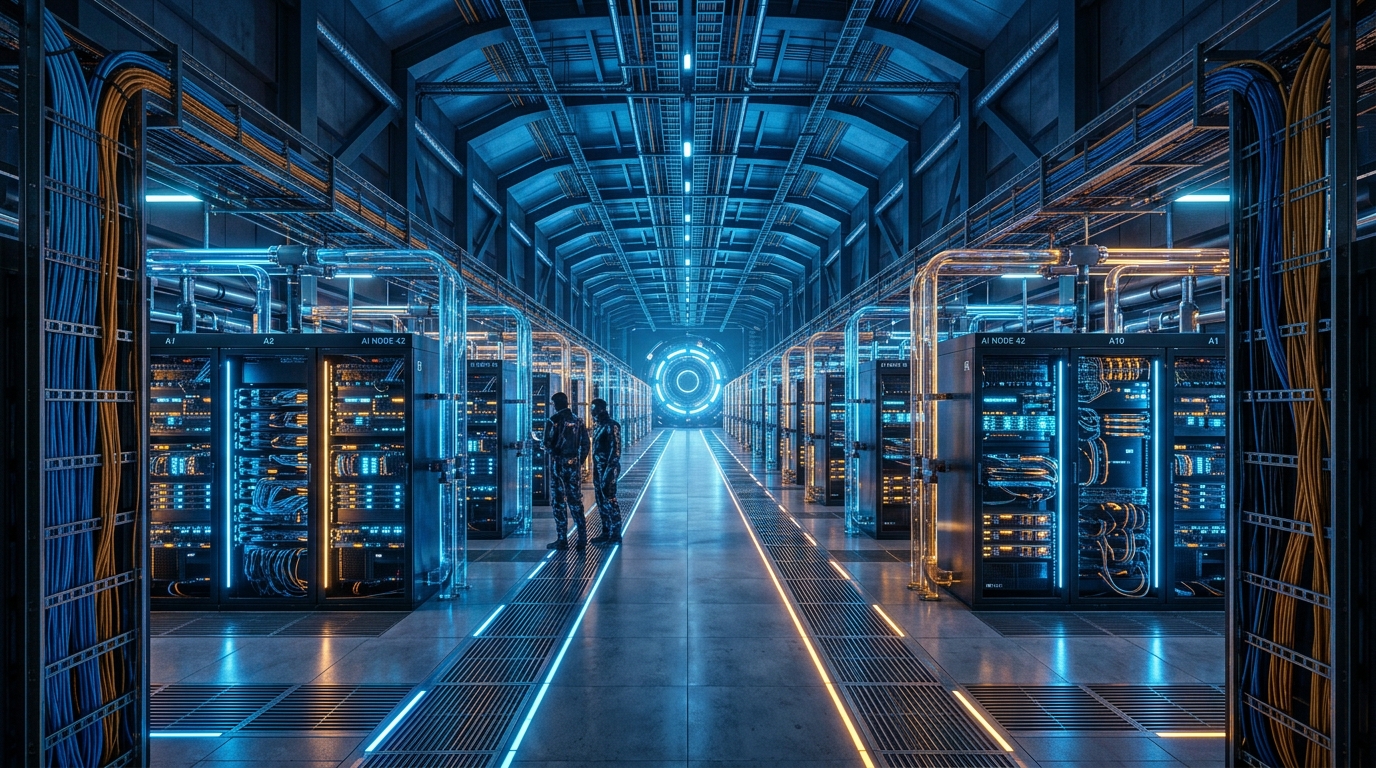
Traditional server facilities were built to accommodate standard racks drawing between 5 to 12 kilowatts (kW) of power. In contrast, modern technology industry AI compute pods loaded with high-density accelerators draw upwards of 40 to 120 kW per rack. This tenfold increase in power density has forced engineers to redesign data center networking and mechanical topologies.
- Silicon Photonics and Co-Packaged Optics: Traditional copper cabling experiences high signal attenuation at terabit speeds. Next-generation technology industry AI facilities utilize 800Gbps and 1.6Tbps optical transceivers to interconnect tens of thousands of GPU nodes into unified virtual fabrics.
- High-Speed Interconnects (NVLink & Ultra Ethernet): Distributed tensor training demands lossless packet switching. Advanced networking fabrics eliminate micro-burst buffer congestion, keeping compute cores saturated during heavy mathematical processing.
- Direct NVMe Storage Tiering: High-throughput flash storage arrays stream terabytes of training checkpoints per second directly into GPU memory without creating I/O bottlenecks.
To discover more about enterprise hardware breakthroughs, explore our dedicated updates in Industry News and Company & Startup News.
Technology Industry AI Comparison Matrix: Traditional vs Next-Gen Facilities
The ongoing structural shift across the technology industry AI landscape has established distinct architectural differences between conventional cloud facilities and modern AI acceleration hubs:
| Metric / Architectural Layer | Traditional Cloud Data Center | Next-Gen AI Acceleration Hub | Operational Impact |
|---|---|---|---|
| Power Density Per Rack | 5 kW – 12 kW | 40 kW – 120 kW+ | Requires dedicated substation power feeds |
| Primary Cooling Method | Computer Room Air Handling (CRAH) | Direct-to-Chip & Immersion Liquid Cooling | Near-zero water consumption & lower PUE |
| Internal Network Fabric | 10G / 40G Standard Ethernet | 800G / 1.6T RoCEv2 & InfiniBand Optics | Microsecond latency for multi-node training |
| Compute Architecture | General-purpose x86/ARM CPUs | Massive Parallel Tensor GPUs / Custom ASICs | Optimized for matrix math and FP8/FP4 math |
| Primary Workload Nature | Stateless Web Apps & SQL Databases | Continuous Neural Model Training & Inference | Sustained 100% thermal and compute duty cycle |
| Data Storage Tiering | SATA/SAS SSDs & Object Storage | PCIe Gen5 Direct NVMe Storage Fabrics | Massive sequential checkpoint read/write rates |
The Energy Challenge: Gigawatt Grids, Nuclear PPAs, and Liquid Cooling
The most demanding operational challenge facing the technology industry AI sector in 2026 is electrical grid capacity. Industrial supercomputing campuses require hundreds of megawatts—and in major planned developments, multiple gigawatts—of continuous baseload power.
As reported by Reuters, major cloud leaders are executing long-term Power Purchase Agreements (PPAs) with zero-carbon energy providers, including small modular nuclear reactors (SMRs), geothermal plants, and utility-scale solar-battery storage installations.
Simultaneously, environmental regulations have accelerated the adoption of closed-loop liquid cooling. By circulating non-conductive dielectric fluid directly over silicon processors, the technology industry AI infrastructure stack eliminates evaporative water cooling towers entirely, achieving Power Usage Effectiveness (PUE) ratings below 1.15 while consuming effectively zero municipal water.
To convert and calculate energy and data transmission units, use our free Unit Converter Calculator.
Enterprise Integration: Moving AI Models From Pilots to Production
The rapid maturation of cloud infrastructure enables enterprises across banking, healthcare, logistics, and manufacturing to harness artificial intelligence without constructing private on-premise server facilities. Through managed technology industry AI cloud APIs, businesses can orchestrate:
- Automated Compliance & Document Auditing: Processing hundreds of thousands of legal and regulatory filings per hour with continuous verification.
- Autonomous Agent Swarms: Deploying multi-agent workflows to handle customer inquiries, order logistics, and code quality testing.
- Dynamic Supply Chain Forecasting: Predicting inventory requirements, shipping route bottlenecks, and market fluctuations in real time.
Research published by McKinsey & Company shows that organizations adopting integrated technology industry AI infrastructure achieve up to 40% higher return on investment compared to those operating isolated, fragmented pilots.
Workforce Evolution: New Engineering Demands in Cloud Infrastructure
The construction and maintenance of modern data center infrastructure has catalyzed widespread demand for specialized technical engineering talent across the technology industry AI domain. Building and operating planetary-scale computing grids requires multidisciplinary expertise spanning:
- Site Reliability & Cloud Network Engineers: Specializing in high-throughput InfiniBand switching, BGP routing, and automated zero-touch provisioning.
- Thermal & Mechanical Facilities Experts: Managing high-pressure dielectric liquid pumps, closed-loop chillers, and substation power distribution.
- Confidential Computing & Cybersecurity Analysts: Implementing zero-trust hardware isolation, post-quantum cryptography, and continuous compliance monitoring.
Technology leaders are partnering with universities and technical institutes to train millions of engineers worldwide, ensuring human operational capacity keeps pace with digital hardware growth.
Strategic Outlook: What the Infrastructure Shift Means for Consumers
While the complex engineering of semiconductor fabrication and power grid management occurs behind the scenes, consumers experience the direct benefits every day. Low-latency edge data centers translate directly into faster mobile applications, seamless live audio translation, more capable voice assistants, and highly secure digital banking.
The ongoing evolution of the technology industry AI landscape proves that artificial intelligence is far more than software algorithms—it is the foundational computing grid of the 21st century. The companies and nations investing in resilient, energy-efficient, and geographically diverse infrastructure today will define the next fifty years of global technological innovation.