Keeping up with the latest ai trends is critical for entrepreneurs, software engineers, and modern business leaders looking to stay competitive in an accelerating digital economy. Artificial intelligence has evolved far beyond experimental research into a transformative utility driving autonomous decision-making, physical robotics, enterprise workflows, and creative multimedia generation across the globe.
As technology rapidly matures, analyzing major ai trends provides crucial foresight into how foundational models, hardware innovations, and autonomous software agents reshape modern industries. From multimodal reasoning systems to on-device edge intelligence, organizations that strategically embrace these developments will dominate the next wave of global economic productivity.
In this authoritative guide to ai trends, we examine the core breakthroughs, industry shifts, and technological paradigms defining the modern computing era. Discover how these transformative advancements will influence enterprise software, hardware infrastructure, and autonomous agentic ecosystems.

AI Trends: The Foundational Pillars Defining Modern Intelligence
The artificial intelligence ecosystem has transitioned from simple text prediction into complex, multi-modal reasoning engines. According to global technology research from Gartner Research and the Stanford Institute for Human-Centered AI, dominant ai trends are characterized by autonomy, localized edge deployment, and hardware specialization.
Where organizations previously utilized artificial intelligence solely for passive data analytics, today’s intelligent systems actively execute multi-step workflows, write and debug software code, orchestrate supply chains, and interact in real-time with physical environments. Understanding the core mechanisms behind how generative AI works allows technology leaders to separate short-term hype from foundational, long-term technological shifts.
These paradigm shifts are driven by continuous scaling laws, synthetic dataset generation, and innovative architectural designs that enable models to solve complex mathematical problems and write full-scale software applications with minimal latency.
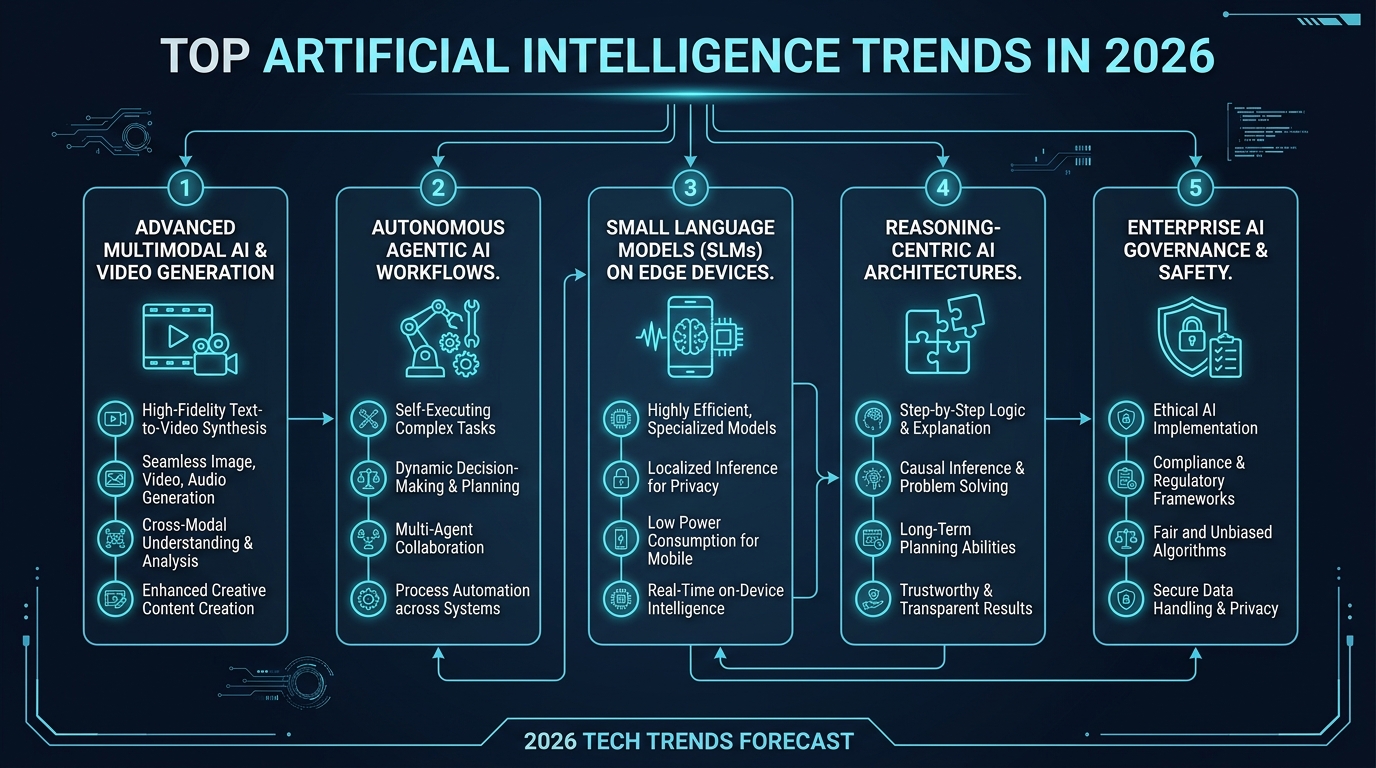
1. Autonomous AI Agents and Agentic Multi-Step Reasoning
Among the most disruptive movements in technology is the evolution from static conversational chatbots into autonomous AI agents. Rather than requiring continuous human prompting for each individual task, agentic AI frameworks break complex strategic objectives down into actionable sequential sub-tasks.
These autonomous agents utilize iterative feedback loops, chain-of-thought verification, and external tool protocols (such as browsing the live web, executing SQL database queries, and modifying software repositories). In enterprise automation, agentic teams collaborate asynchronously—where one specialized agent drafts code, another conducts automated security testing, and a third deploys the application directly into cloud environments.
2. Embodied AI and Physical Robotics Integration
The convergence of Vision-Language-Action (VLA) models and robotic hardware represents one of the fastest-growing sectors in computing. Researchers at leading artificial intelligence labs are embedding foundational models directly into bipedal humanoid robots, automated warehouse machinery, and robotic surgical assistants.
By processing sensory inputs through multi-modal spatial transformers, physical robots learn to interpret unstructured real-world environments without requiring rigid, hand-coded kinematic instructions. These developments are revolutionizing manufacturing assembly lines, fulfillment logistics, agriculture, and healthcare operations across international markets.
3. Edge AI and On-Device Small Language Models (SLMs)
While multi-hundred-billion parameter models power cloud datacenters, one of the most practical developments is the proliferation of high-performance Small Language Models (SLMs) designed for local edge deployment. Models ranging from 1 billion to 8 billion parameters (such as Llama 3.2, Microsoft Phi-3.5, and Google Gemma 2) can now execute smoothly on consumer smartphones, laptops, and automotive microcontrollers.
Running intelligence directly at the edge offers immense commercial advantages for businesses:
- Zero-Latency Processing: Immediate inference without waiting for round-trip cloud network requests.
- Complete Data Privacy: Confidential user data and enterprise trade secrets never leave the local hardware device.
- Offline Resilience: Full operational capability even in air-gapped environments or regions with unreliable internet connectivity.
- Substantial Cost Reductions: Drastic reduction in cloud server compute fees and API token expenses.
4. Test-Time Compute and System-2 Chain-of-Thought Reasoning
A pivotal shift in modern machine learning is the emergence of test-time compute paradigms (exemplified by OpenAI o1, o3, and DeepSeek-R1). Rather than generating instantaneous next-token predictions (System-1 thinking), these models dedicate seconds or minutes of computational effort during inference to deliberate, backtrack, and verify intermediate reasoning steps (System-2 thinking).
This architectural evolution dramatically reduces factual hallucinations in competitive programming, formal mathematical proofs, legal contract verification, and complex biomedical research, establishing a new frontier for automated scientific discovery.
5. Specialized AI Chips and Energy-Efficient Silicon Architectures
The exponential compute demands of modern deep learning have made specialized hardware one of the most critical sectors to monitor. As detailed in our comprehensive guide to AI chips, semiconductor giants and hyperscale cloud providers are designing dedicated Application-Specific Integrated Circuits (ASICs), Tensor Processing Units (TPUs), and Neural Processing Units (NPUs).
Published research in peer-reviewed repositories such as arXiv Computer Science highlights how innovations in high-bandwidth memory (HBM3e/HBM4), liquid cooling infrastructure, and low-precision mathematical formats (FP4 and INT8) allow frontier models to train and infer at unprecedented energy efficiency levels.
6. Enterprise AI Governance, Ethics, and Model Alignment
As artificial intelligence becomes deeply integrated into healthcare, financial services, and mission-critical infrastructure, regulatory compliance has become central to emerging enterprise strategies. Global frameworks such as the European Union AI Act and international safety standards mandate strict audits for algorithmic bias, data lineage, and safety alignment.
Enterprises are increasingly adopting automated red-teaming pipelines, Constitutional AI architectures, and cryptographic watermarking technologies to prevent hallucinated outputs, intellectual property leakage, and malicious prompt injections across production deployments.
Comparative Strategic Matrix: Top AI Trends and Industry Impact
This strategic comparison matrix evaluates the primary sectors, their current adoption maturity, and their projected market impact across core industries:
| Strategic AI Pillar | Core Technology Driver | Adoption Phase | Primary Beneficiary Sectors |
|---|---|---|---|
| Agentic Automation | Multi-Agent Orchestration & Tool Calling | Rapid Enterprise Expansion | Software Dev, Finance, Customer Operations |
| Physical Robotics | Vision-Language-Action (VLA) Foundations | Early Commercial Deployment | Logistics, Manufacturing, Healthcare |
| Edge & Local SLMs | 4-bit Quantization & Compact Distillation | Mass Market Integration | Consumer Tech, Automotive, Mobile Devices |
| Test-Time Compute | Inference Deliberation & System-2 Reasoning | Frontier Scaling | Scientific Research, Legal, Quantitative Finance |
| Custom AI Silicon | HBM4, 2nm Nodes & Dedicated TPUs/NPUs | Industrial Scaling | Cloud Datacenters, Telecommunications |
| Safety Governance | RAG Verification & Constitutional AI | Global Compliance Mandate | Banking, Legal, Public Administration |
How Businesses Can Leverage AI Trends for Exponential Growth
Understanding macro industry shifts is only valuable if transformed into practical execution. Organizations of all sizes can capitalize on these technological developments by implementing structured adoption workflows:
- Deploy Enterprise AI Productivity Tools: Equip knowledge workers with the best AI productivity tools to automate routine correspondence, data synthesis, and presentation generation.
- Automate Complex Workflows: Integrate end-to-end AI automation workflows to connect CRM pipelines, customer support tickets, and inventory management systems.
- Master Conversational Interfaces: Train employees on advanced prompting frameworks through our step-by-step tutorial on how to use ChatGPT.
- Implement Domain-Specific RAG Pipelines: Connect proprietary corporate knowledge bases with frontier models to enable accurate, hallucination-free decision support.
Frequently Asked Questions: AI Trends (FAQs)
What are the most significant AI trends driving enterprise technology today?
The most influential developments include autonomous AI agents, on-device Small Language Models (SLMs), specialized neural accelerator chips, multimodal physical robotics, test-time compute reasoning, and enterprise safety alignment frameworks.
How will agentic AI change the future of knowledge work?
Agentic AI shifts artificial intelligence from a passive conversational assistant into an active autonomous collaborator capable of planning multi-step projects, calling APIs, querying databases, and executing entire business workflows with minimal human oversight.
Why are Small Language Models (SLMs) gaining popularity over massive LLMs?
Small Language Models deliver exceptional task-specific accuracy with minimal latency, zero cloud computing costs, offline reliability, and absolute user data privacy when executed directly on local consumer hardware.
How can small businesses adopt these artificial intelligence innovations?
Small businesses can start by adopting commercial productivity tools, leveraging no-code AI workflow automation platforms, and fine-tuning lightweight open-weight models on proprietary customer service data.
Final Thoughts: Preparing for the Future of Intelligent Systems Beyond 2026
The pace of innovation in artificial intelligence shows no signs of slowing down. As these powerful developments continue to mature, the boundary between human strategic creativity and automated machine execution will blur into a unified collaborative ecosystem.
Discover more technology guides and strategic breakdowns on our About Us page, and stay tuned to Osmanix for ongoing analyses of breakthroughs in digital innovation and enterprise computing!