In recent years, the global professional landscape has experienced a monumental transformation. What was once considered an occasional workplace perk has rapidly evolved into a permanent, highly scalable employment standard: remote work. Modern enterprises across technology, finance, marketing, and customer operations now collaborate effortlessly across international time zones without setting foot in a physical office building.
Thriving in a distributed organization requires much more than an internet connection and a laptop. A truly sustainable distributed lifestyle demands disciplined time management, deliberate asynchronous communication, ergonomic workspace design, and continuous mastery of modern cloud applications. Whether you are transitioning to working from home for the first time or leading an international team, building an effective remote work strategy is crucial for long-term career growth.
In this comprehensive guide, we explore the core principles of high-performance distributed teams, analyze the five foundational pillars of distributed organizations, review top collaboration tools, and share 9 actionable strategies to maximize focus, prevent burnout, and excel in 2026.

What Is Remote Work? Core Definition & 2026 Landscape
Remote work is a flexible employment arrangement that enables professionals to execute their primary job responsibilities outside of a centralized company office. Whether operating from a dedicated home office, a shared co-working hub, or while traveling as a digital nomad, distributed professionals leverage secure cloud computing, collaborative project management software, and high-speed internet to remain fully integrated with their teams.
According to recent workplace telemetry from research leaders like Gallup Workplace Insights, over 58% of knowledge workers report that distributed flexibility significantly boosts their job satisfaction, overall wellbeing, and daily output. Companies that embrace distributed operations reduce overhead expenses, expand their talent acquisition boundaries worldwide, and foster high-trust cultures centered on objective output rather than mere physical desk presence.
| Work Model | Location Flexibility | Core Advantage | Primary Operational Focus |
|---|---|---|---|
| Fully Distributed Model | 100% Location Independent | Maximum Schedule Autonomy & Zero Commute | Asynchronous Documentation & Cloud Workflows |
| Hybrid Model | Split Between Office & Home | Balanced In-Person Interaction | Structured In-Office Anchor Days |
| Digital Nomadism | Continuous Global Travel | Global Cultural Experience & Lifestyle Freedom | Mobile Security & Reliable High-Speed Connectivity |
| Traditional Office | Fixed Centralized Facility | Direct Synchronous Physical Access | Real-Time In-Person Team Supervision |
The 5 Foundational Pillars of High-Performance Remote Work
Operating a successful distributed team or managing your personal day-to-day workflow requires establishing five essential operational pillars. When these pillars are synchronized, remote work becomes an unstoppable competitive advantage.
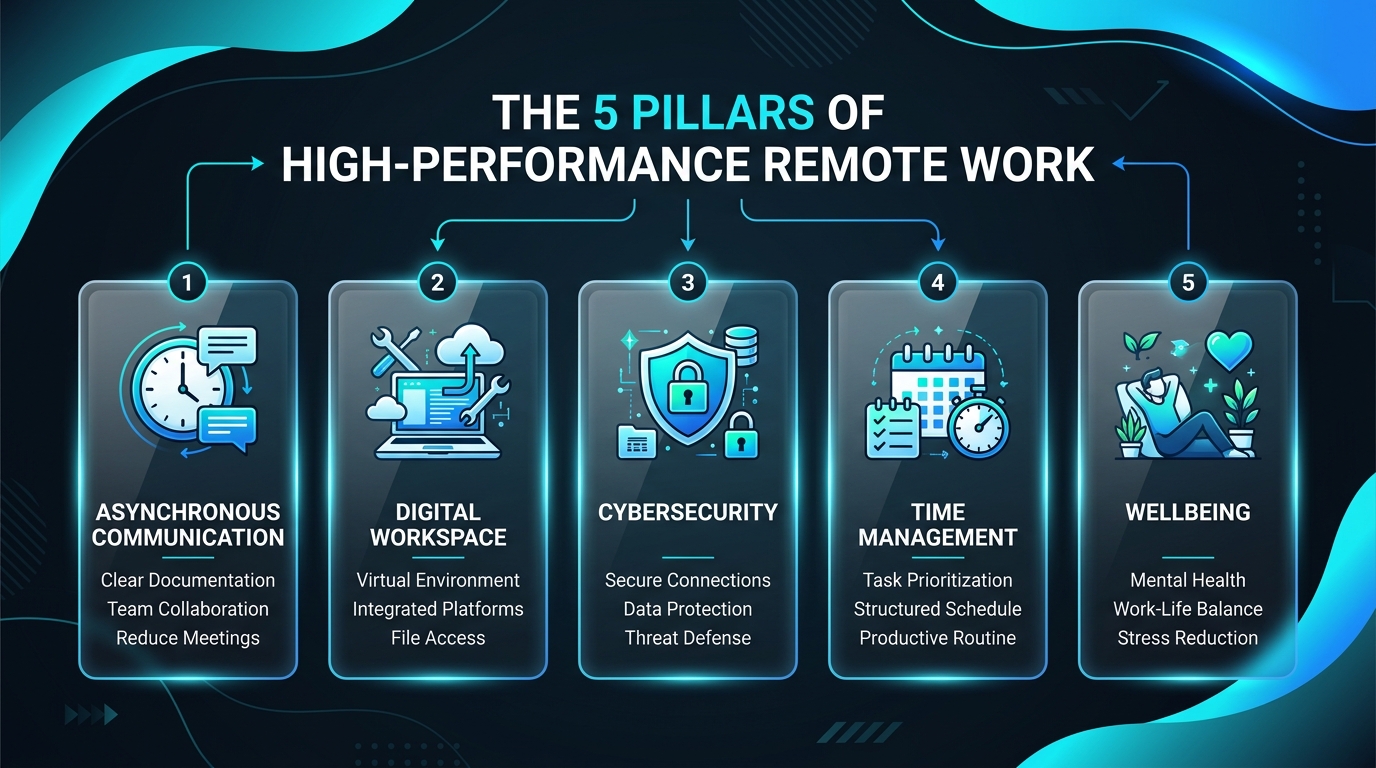
- 1. Asynchronous Communication: Prioritizing clear, detailed written documentation in platforms like Notion Workspace and project trackers minimizes unnecessary video meetings and lets team members contribute across different global time zones without delay.
- 2. Integrated Digital Workspace: Standardizing company knowledge bases, centralized cloud file repositories, and automated ticketing systems ensures every employee has instant access to critical assets.
- 3. Robust Remote Cybersecurity: Enforcing multi-factor authentication (MFA), enterprise virtual private networks (VPNs), endpoint encryption, and strict zero-trust access protocols protects corporate data against unauthorized intrusion.
- 4. Disciplined Time Management: Developing structured daily routines, utilizing time-blocking methods, and defining clear boundaries between active work hours and personal time prevents exhaustion.
- 5. Physical and Mental Wellbeing: Investing in ergonomic seating, proper monitor eye-level alignment, daily physical exercise, and regular social connection safeguards long-term mental health.
Top Tools and Software Powering Remote Work
The right software stack makes all the difference in distributed operations. Modern teams harness cutting-edge tools to maintain real-time alignment and automate repetitive tasks across departments:
- Communication & Team Chat: Real-time and asynchronous team discussions are organized seamlessly through digital messaging hubs like Slack Digital Headquarters and Microsoft Teams.
- AI-Powered Productivity: High-performing professionals leverage the best AI productivity tools to automate email summarization, document generation, and project scheduling.
- Autonomous Task Execution: Deploying autonomous AI agents allows distributed teams to automatically triage support tickets and manage CRM synchronization without manual intervention.
- Cloud Enterprise Infrastructure: As explored in our deep-dive on what is business technology, integrating scalable cloud ERP and SaaS architectures provides uninterrupted service worldwide.
9 Practical Strategies to Excel at Remote Work
Implementing proven daily habits transforms how you experience working outside the traditional office. Here are 9 essential strategies to maximize your output and maintain peak momentum:
1. Design a Dedicated Ergonomic Workspace
Avoid working from the couch or bed. Establishing a dedicated desk with an ergonomic chair, external monitor, and supportive keyboard signals to your brain that it is time to concentrate, improving posture and physical stamina throughout the day.
2. Master the “Fake Commute” Morning Routine
Create a transition habit before starting your workday. Taking a 15-minute morning walk, having a mindful breakfast, and dressing in comfortable professional attire sets a positive psychological boundary between home life and professional duty.
3. Practice Aggressive Time Blocking for Deep Work
Group similar tasks together and schedule uninterrupted 90-minute focus blocks for your highest-impact analytical and creative responsibilities while keeping notifications silenced.
4. Over-Communicate Context and Progress Proactively
In a distributed employment environment, silence creates ambiguity. Proactively post weekly status updates, document decisions in public team channels, and clarify next steps so your colleagues always have complete visibility.
5. Establish Clear End-of-Day Shutdown Rituals
Prevent work from bleeding into your evenings by executing a formal shutdown routine: review tomorrow’s priority list, log off communication apps, and physically leave your desk to disconnect completely.
6. Leverage Asynchronous Video for Complex Updates
Instead of scheduling an immediate 30-minute conference call, record a concise 3-minute screen walk-through using Loom. This respects team schedules and builds an easily shareable visual reference.
7. Optimize Your Home Network and Connectivity
A stable connection is fundamental to smooth digital collaboration. Utilize direct Ethernet cabling or high-performance Wi-Fi 6 mesh routers, and maintain a secondary mobile hotspot backup for emergency connectivity.
8. Schedule Intentional Micro-Breaks Throughout the Day
Adhere to the 20-20-20 rule to reduce digital eye strain: every 20 minutes, look at an object 20 feet away for 20 seconds. Stand up, stretch, and hydrate regularly to maintain mental sharpness.
9. Invest in Continuous Professional Skill Building
Distributed professionals must continuously sharpen their capabilities. Dedicate 2 to 3 hours each week to studying emerging industry frameworks, AI workflows, and project methodologies to remain indispensable.
Overcoming Common Remote Work Challenges
While distributed flexibility offers tremendous rewards, professionals must actively address several common obstacles that arise in independent environments:
- Combating Isolation and Loneliness: Join professional online mastermind communities, attend local co-working spaces once or twice a week, and schedule casual virtual coffee chats with coworkers.
- Managing Digital Distractions: Use website blockers during focus sessions, disable non-essential smartphone alerts, and establish clear house rules with family members regarding your working hours.
- Preventing Constant “Always-On” Burnout: Turn off work chat notifications on your mobile device outside agreed business hours and honor your personal evenings and weekends.
Frequently Asked Questions: Remote Work (FAQs)
How can beginners find legitimate remote work opportunities?
Beginners can find vetted remote work roles on trusted global job platforms like We Work Remotely, FlexJobs, Remote OK, and LinkedIn by filtering specifically for distributed and work-from-home positions.
What is the most crucial skill for successful remote work?
Proactive written communication and self-discipline are the most critical skills. Being able to explain ideas concisely, manage deadlines autonomously, and solve problems without direct supervision ensures success in any distributed team.
How do employers measure distributed productivity?
Modern distributed companies evaluate employees based on measurable deliverables, project completion quality, and objective KPIs rather than hours spent seated at a desk.
Final Thoughts on the Future of Remote Work
The future of employment is undeniably distributed, flexible, and global. By developing intentional daily habits, mastering digital collaboration tools, and prioritizing healthy work-life integration, you can achieve unmatched autonomy while delivering exceptional professional results through remote work.
Discover more career growth playbooks and technology strategies on our About Us page, and subscribe to our newsletter for weekly updates!