Exploring what are gadgets and how they shape modern consumer habits is essential for tech enthusiasts, digital professionals, and smart home innovators. From smartphones and biometric smartwatches to foldable displays, spatial computing headsets, and connected smart home hubs, modern consumer hardware has transitioned into an intelligent, interconnected ecosystem.
At their core, what are gadgets? They are specialized electronic devices engineered with dedicated microcontrollers, wireless transceivers, and intuitive user interfaces designed to streamline daily tasks, augment personal productivity, monitor biometric health, and enhance digital connectivity.
According to technical specifications from the IEEE Consumer Technology Society Standards and the Connectivity Standards Alliance (Matter Protocol), the gadget landscape is undergoing massive convergence driven by on-device neural processing and universal IoT protocols. In this comprehensive technical breakdown, we examine the major categories, silicon innovations, and smart device ecosystems transforming our daily lives.
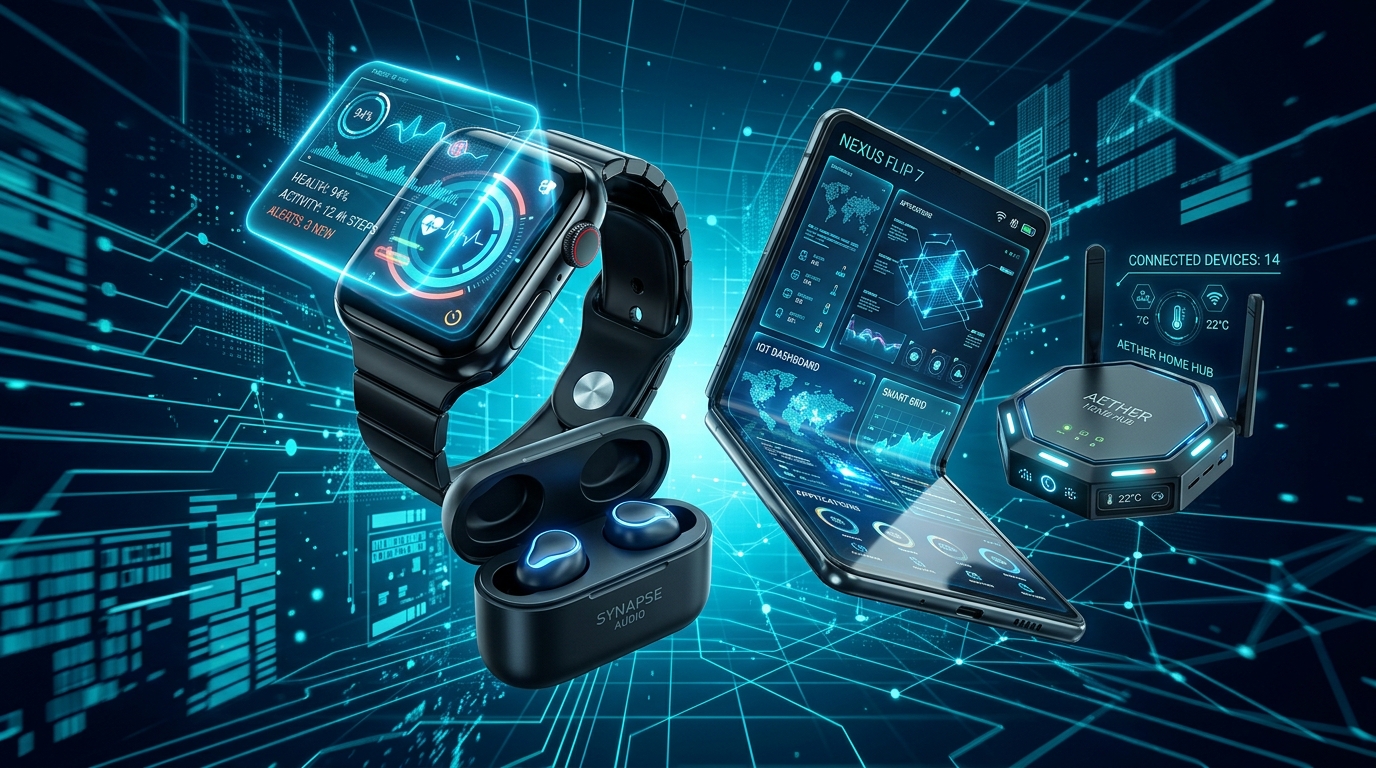
What Are Gadgets and How Do They Work?
To understand what are gadgets from an engineering perspective, we look at the integration of System-on-Chip (SoC) microarchitecture, ultra-low-power microcontrollers, MEMS sensors (accelerometers, gyroscopes, PPG optical sensors), and wireless communication stacks (Bluetooth Low Energy, Wi-Fi 7, Ultra-Wideband, and Thread).
Unlike monolithic single-purpose machines of the past, modern gadgets function as intelligent edge computing nodes. As explored in our guide on what is emerging technology, consumer gadgets continuously synchronize telemetry with cloud platforms and execute real-time local machine learning inferences to deliver contextual assistance.
This combination of miniaturized computing hardware, sophisticated real-time operating systems (RTOS), and distributed wireless protocols enables devices to interact seamlessly across home, vehicle, and office environments, forming an essential component of modern what is business technology infrastructure.
Wearable Technology: Smartwatches, Fitness Trackers, and Smart Rings
Wearables represent the fastest-growing category of consumer technology, transforming personal health monitoring into an accurate, continuous diagnostic tool:
- Smartwatches: Feature electrocardiogram (ECG) sensors, blood oxygen (SpO2) monitors, dual-frequency GPS, and standalone cellular connectivity, allowing users to make calls and handle notifications untethered from a smartphone.
- Fitness Trackers: Optimized for ultra-long battery endurance, focusing on continuous heart rate tracking, sleep architecture analysis, and metabolic recovery scoring.
- Smart Rings: Compact form-factor wearables equipped with infrared PPG sensors and temperature sensors, providing discreet overnight sleep and biometric strain tracking without screen distractions.

Portable Audio and Communication: Wireless Earbuds and Active Noise Cancellation
True Wireless Stereo (TWS) earbuds have evolved into complex computational audio engines. Modern earbuds incorporate multi-microphone beamforming arrays, outward-facing and inward-facing error microphones, and real-time DSP chips to deliver Adaptive Active Noise Cancellation (ANC) and spatial audio with dynamic head tracking.
For professionals utilizing remote work productivity tools, premium wireless earbuds provide seamless multi-point Bluetooth pairing across laptops and mobile devices, ensuring crystal-clear voice isolation during video conferencing and deep focus sessions, aligning with modern productivity frameworks.
Smart Home Automation: IoT Hubs, Matter Protocol, and Connected Devices
The smart home ecosystem previously suffered from fragmented proprietary protocols. The universal adoption of the Matter standard and Thread wireless mesh networking has unified smart home gadgets across Apple Home, Google Home, Amazon Alexa, and Home Assistant.
Smart home gadgets—ranging from automated smart thermostats and motorized blinds to video doorbells and robotic vacuum cleaners—now execute local automation routines over Thread mesh networks without sending local control commands through cloud servers, dramatically reducing latency and improving operational reliability.
On-Device Artificial Intelligence and Neural Processing Units (NPUs)
The integration of dedicated Neural Processing Units (NPUs) in modern mobile chips represents a major leap forward for consumer devices, as detailed in our analysis of AI semiconductor chips.
Rather than offloading every voice request, photo enhancement, or text summarization task to remote cloud data centers, on-device NPUs execute multi-billion parameter Small Language Models (SLMs) locally. This delivers instantaneous computational response times, offline functionality, and superior data privacy.
Spatial Computing, Mixed Reality Headsets, and Gaming Handhelds
Entertainment and personal computing are undergoing significant evolution through immersive spatial hardware. Mixed reality headsets utilize high-resolution micro-OLED passthrough cameras, eye-tracking sensors, and real-time hand tracking to project virtual floating displays into physical rooms.
Simultaneously, portable PC gaming handhelds incorporate custom AMD and ARM APUs with integrated RDNA graphics, enabling triple-A console gaming on 7-inch 120Hz VRR displays anywhere in the world.
Next-Gen Display Innovations: Foldable Screens, OLED, and MicroLED
Display technologies have broken free from rigid glass rectangles. Foldable OLED smartphones utilize flexible ultra-thin glass (UTG) and complex multi-gear teardrop hinges to transform pocketable smartphones into 8-inch multitasking workstations.
Concurrently, MicroLED and tandem OLED panels deliver pixel-level dimming, infinite contrast ratios, and extreme peak brightness exceeding 3,000 nits, ensuring daylight legibility across outdoor smartwatches and drone remote displays.
Battery Advancements, Fast Charging, and Universal USB-C Ecosystems
Battery longevity remains a core consumer consideration. Innovations in Silicon-Carbon (Si/C) anode chemistry allow gadget manufacturers to pack significantly higher energy density into thinner device profiles.
Simultaneously, the global standardization of USB-C Power Delivery (USB-PD 3.1) and Gallium Nitride (GaN) fast-charging bricks enables a single compact 100W adapter to charge a laptop, tablet, smartphone, and smartwatch rapidly using universal cables.
Smart Gadget Privacy, Data Governance, and Device Security
Because smart gadgets capture continuous audio, video, location, and biometric telemetry, securing IoT hardware is paramount:
As detailed in our authoritative guides on what is digital privacy and what is cybersecurity, smart device owners must practice strict digital hygiene: isolating smart home gadgets on a dedicated guest Wi-Fi VLAN, disabling unneeded cloud voice recording storage, auditing microphone permissions, and installing firmware security patches promptly.
Comparative Matrix: Essential Consumer Gadget Categories and Specifications
The following architectural matrix compares major modern consumer gadget categories, their core technologies, and primary use cases:
| Gadget Category | Core Hardware Technologies | Primary Wireless Protocols | Typical Battery Life | Primary Value Proposition |
|---|---|---|---|---|
| Smartwatches | OLED, Optical PPG, ECG, Dual GPS | Bluetooth LE, Wi-Fi, eSIM LTE | 1 to 5 Days | Health diagnostics & notifications |
| Wireless Earbuds (TWS) | DSP Chip, ANC Microphones, MEMS Drivers | Bluetooth 5.4, AAC/LDAC Codecs | 6 to 30 Hours (with Case) | Computational audio & focus isolation |
| Smart Home Hubs | Microcontroller, Speaker/Display, Thread Radio | Matter, Thread, Wi-Fi 6, Zigbee | Mains Powered (AC) | Centralized localized home automation |
| Foldable Smartphones | Flexible OLED, Ultra-Thin Glass, Dual SoCs | 5G Sub-6/mmWave, Wi-Fi 7, UWB | 1 to 2 Days | Compact portability with tablet productivity |
| Spatial XR Headsets | Micro-OLED, LiDAR, Eye Tracking, Dual SoCs | Wi-Fi 6E/7, Bluetooth 5.3 | 2 to 3 Hours | Spatial computing & 3D visualization |
| Smart Rings | Infrared PPG, Temperature Sensor, Titanium Casing | Bluetooth Low Energy | 4 to 7 Days | Screen-free sleep & recovery tracking |
Sustainable Technology: Device Longevity, E-Waste, and Right to Repair
As consumer electronics proliferate, environmental sustainability and electronic waste (e-waste) management have become critical priorities for technology manufacturers and consumers alike.
Leading technology companies are extending guaranteed software support windows to seven years of OS upgrades, utilizing 100% recycled aluminum and rare earth elements, and designing modular hardware with accessible replacement parts to support consumer Right-to-Repair initiatives.
Frequently Asked Questions: Gadgets and Smart Devices (FAQs)
What are gadgets primarily used for in daily life?
Gadgets are electronic devices designed to simplify everyday tasks, enhance mobile communication, track health and fitness biometrics, automate home environments, and improve professional productivity.
What is on-device AI in modern smartphones and wearables?
On-device AI executes machine learning models directly on the gadget’s internal Neural Processing Unit (NPU) without sending data to cloud servers, providing instant response times, offline functionality, and improved privacy.
How does the Matter protocol benefit smart home gadgets?
The Matter protocol is an open smart home connectivity standard that allows smart devices from different brands to communicate seamlessly and operate locally without relying on proprietary cloud bridges.
How can users protect their privacy on connected smart devices?
Users can safeguard privacy by isolating smart devices on a separate Wi-Fi network, disabling unneeded cloud data tracking, managing app permissions, using strong unique passwords, and keeping firmware updated.
Summary & Key Takeaways: Building a Seamless Smart Device Ecosystem
Understanding what are gadgets and choosing the right combination of connected hardware empowers users to construct an efficient, health-conscious, and automated lifestyle. By prioritizing interoperable standards like Matter, on-device AI processing, robust privacy controls, and long-term repairability, you create a future-proof personal tech ecosystem.
To explore more expert breakdowns on modern hardware, cloud infrastructure, and software frameworks, visit our About Us overview and check our comprehensive technology library.