Understanding what is e-commerce and how modern digital transactions operate has become indispensable for entrepreneurs, corporate leaders, and consumers in today’s borderless global marketplace. Electronic commerce—commonly abbreviated as e-commerce—refers to the buying and selling of goods, digital products, and specialized services across the internet, supported by automated electronic payments and cloud computing infrastructure.
From agile direct-to-consumer (D2C) brands to enterprise marketplaces processing billions in transactions, exploring what is e-commerce reveals a sophisticated digital ecosystem. Modern storefronts leverage mobile commerce, real-time inventory management, predictive artificial intelligence, and automated supply chains to deliver personalized shopping experiences to billions of consumers worldwide.
In this authoritative 2026 guide, we explore what is e-commerce, examine its foundational business models, outline the complete digital transaction lifecycle, and provide an actionable blueprint to help you launch and scale a profitable online enterprise.

What Is E-commerce? Definition and Fundamental Mechanics
At its core, what is e-commerce describes any commercial exchange conducted over computer networks. While traditional commerce necessitates a physical storefront, cash registers, and in-person foot traffic, an e-commerce platform relies on web hosting servers, digital product catalogs, secure payment gateways, and logistics distribution networks to complete sales automatically 24 hours a day, 7 days a week.
According to macroeconomic data published by Statista Global Commerce Insights, worldwide retail e-commerce sales have surpassed $6.5 trillion annually, accounting for over 22% of total global retail spending. Learning what is e-commerce enables founders to tap into an unprecedented global consumer base with significantly lower capital requirements than physical stores.
The E-commerce Ecosystem: How Online Transactions Work
To truly grasp what is e-commerce, it is helpful to analyze the interconnected components that facilitate every digital purchase:
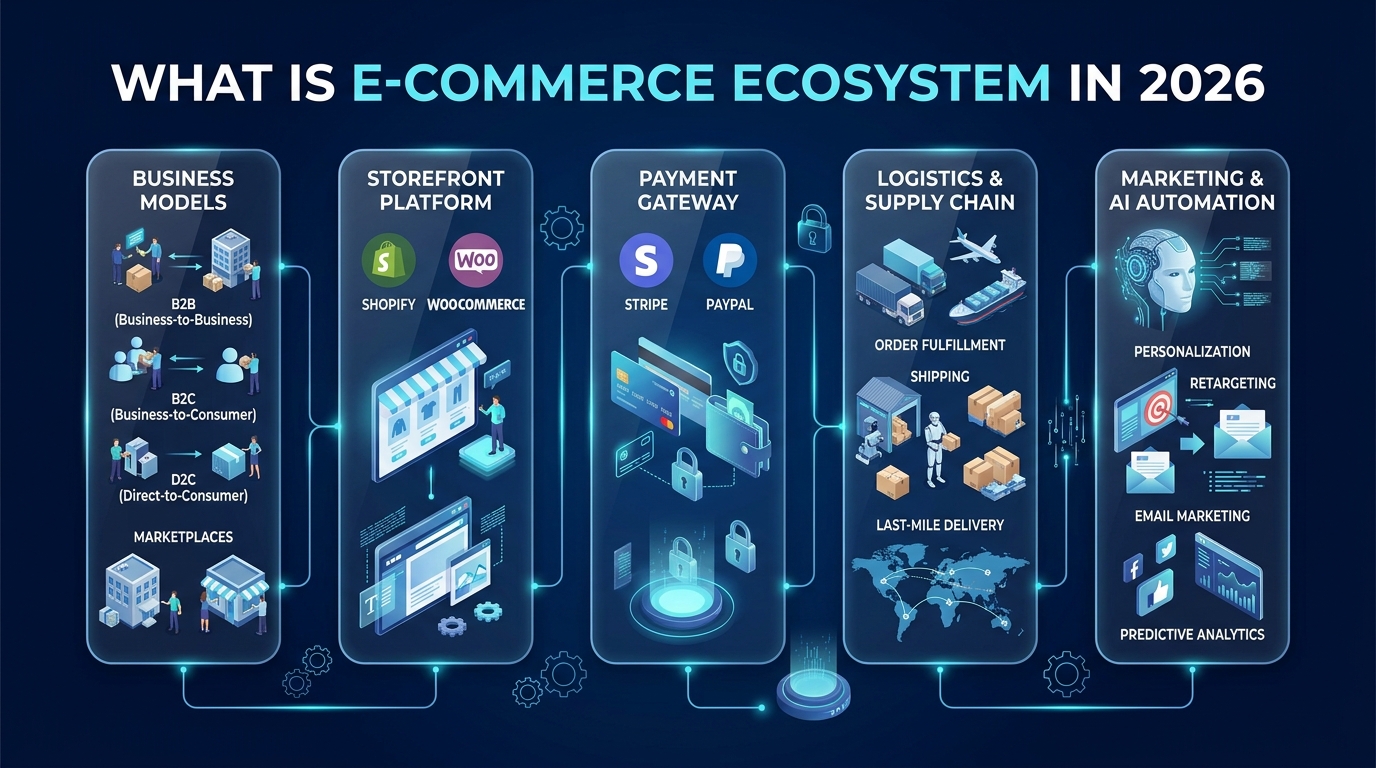
- 1. Digital Storefront: The customer-facing web interface built on hosted platforms like Shopify Commerce or open-source solutions like WooCommerce Platform.
- 2. Product Information Management (PIM): High-resolution product photography, detailed copy, technical specifications, customer reviews, and real-time inventory levels.
- 3. Payment Gateway & Processing: Encrypted financial gateways such as Stripe Merchant Services and digital wallets that authorize transactions securely.
- 4. Order Management and Fulfillment: Automated warehousing, pick-pack-ship workflows, third-party logistics (3PL), and last-mile tracking updates sent directly to shoppers.
- 5. Customer Support & Retention: Integrated CRM systems, live chatbots, and automated email flows that manage post-purchase engagement.
The 6 Major Types of E-commerce Business Models
When evaluating what is e-commerce, digital businesses are categorized according to who is selling to whom. The six dominant business classifications include:
1. Business-to-Consumer (B2C) E-commerce
The most recognizable form of what is e-commerce, where businesses sell goods or services directly to individual consumers (e.g., purchasing apparel on Nike.com or ordering household essentials on Amazon).
2. Business-to-Business (B2B) E-commerce
In B2B commerce, companies trade products or services with other enterprises. This includes wholesale distribution, bulk raw material procurement, and enterprise software licenses with customized pricing tiers.
3. Direct-to-Consumer (D2C) E-commerce
D2C eliminates middlemen, wholesalers, and retail distributors by manufacturing products and marketing them straight to consumers through branded online storefronts, maximizing margin control and customer data ownership.
4. Consumer-to-Consumer (C2C) E-commerce
Peer-to-peer marketplaces where individual users sell goods directly to other consumers, facilitated by platforms like eBay, Etsy, and Facebook Marketplace.
5. Consumer-to-Business (C2B) E-commerce
Where individuals offer value, services, or assets to commercial entities. A prime example is our detailed guide on how to start freelancing, where independent professionals sell specialized expertise directly to corporations.
6. Business-to-Government (B2G) E-commerce
Specialized digital portals where private sector companies provide cybersecurity, infrastructure software, and goods to public sector municipal and federal government agencies.
E-commerce vs. Traditional Retail: Strategic Comparison
Understanding what is e-commerce requires contrasting its operational dynamics against traditional physical retail:
| Operating Characteristic | Traditional Physical Retail | Modern E-commerce Platform | Founder Strategic Impact |
|---|---|---|---|
| Setup & Capital | $50,000 – $250,000+ (Leases, Fixtures) | $200 – $2,500 (Software & Domain) | Extremely Low Barrier to Entry |
| Market Reach | Restricted to Local Vicinity | Global Audience Across All Timezones | Infinite Market Scaling Potential |
| Operating Hours | Fixed Store Hours (8-12 hrs/day) | Open 24/7/365 Non-Stop | Continuous Autonomous Revenue |
| Customer Analytics | Limited In-Store Footfall Data | Granular Heatmaps & Pixel Attribution | Precision Retargeting & High ROI |
| Inventory Agility | Expensive Physical Warehousing | On-Demand, Dropshipping, or 3PL | Optimized Working Capital Flow |
Essential Platforms and Technology for E-commerce Success
Deploying a resilient commerce brand requires selecting robust enterprise software. Research published by Forbes Technology Council underscores that leveraging modern business technology increases store conversion rates by up to 35%.
- Core E-commerce Engines: Shopify, BigCommerce, and WooCommerce for rock-solid transaction security, inventory catalogs, and checkout optimization.
- Business Technology Systems: Integrate cloud software outlined in our what is business technology guide to connect ERP, CRM, and financial accounting.
- Autonomous AI Agents: Deploy intelligent AI agents to automate 24/7 customer service inquiries, handle order tracking, and recommend complementary products.
- Productivity & Team Workflows: Utilize top-rated best AI productivity tools and frameworks from our how to improve productivity guide to streamline administrative duties.
- Distributed Operations: Coordinate distributed supply chain teams using best practices from our remote work guide.
Step-by-Step Guide: How to Launch an E-commerce Brand in 2026
If you want to apply what is e-commerce principles to build a profitable enterprise, follow our step-by-step launch methodology:
Frequently Asked Questions: What Is E-commerce? (FAQs)
What is e-commerce in simple terms?
In simple terms, what is e-commerce refers to buying and selling goods, services, or digital downloads over the internet using computers, tablets, or smartphones.
How much capital do I need to start an e-commerce business?
You can launch a lean e-commerce store with $200 to $1,000 for dropshipping or digital products. Custom physical inventory and direct manufacturing typically require between $2,500 and $10,000 in initial working capital.
Is e-commerce still profitable in 2026?
Yes. E-commerce remains extraordinarily lucrative for brands that offer differentiated products, compelling storytelling, excellent customer service, and optimized multi-channel marketing funnels.
Summary & Key Takeaways: The Future of What Is E-commerce
Mastering what is e-commerce opens limitless commercial opportunities in the digital era. By integrating state-of-the-art storefront technology, offering seamless checkout experiences, and deploying customer-first marketing strategies, founders can build enduring, scalable, and highly valuable digital assets.
Discover more digital commerce playbooks and actionable business guides on our About Us page, and subscribe to our newsletter for weekly insights on modern entrepreneurship!