Implementing modern ai automation has become a defining competitive advantage for forward-thinking organizations, digital creators, and enterprise operations worldwide. By transitioning from rigid legacy rule-based scripts to adaptive cognitive intelligence, organizations can streamline intricate business processes, eradicate repetitive manual workloads, and scale commercial productivity with unprecedented speed.
Unlike traditional automation tools that break whenever unstructured data or unexpected exceptions occur, intelligent ai automation leverages large language models, computer vision, and machine learning pipelines to parse documents, make autonomous contextual decisions, and trigger complex multi-application workflows without continuous human intervention.
In this authoritative master guide to ai automation, we explore the core architectural layers, practical integration blueprints, and strategic frameworks needed to automate modern operations. From robotic process automation (RPA) and autonomous agent swarms to enterprise ERP synchronization, learn how to build resilient automated business systems.

AI Automation: Understanding Cognitive vs. Traditional Automation
To fully capitalize on modern technological capabilities, engineering and operations teams must understand the foundational distinction between classic deterministic automation and cognitive ai automation. Traditional Robotic Process Automation (RPA) executes predefined scripts across static user interfaces; if a button moves or a document layout changes slightly, the pipeline crashes.
According to comprehensive research by McKinsey & Company and Gartner Research, intelligent systems incorporate probabilistic machine learning models to dynamically interpret context, extract semantically rich entities from unstructured PDFs or emails, and make adaptive decisions on the fly.
By combining generative reasoning with robust API webhooks, modern automation architectures create self-healing execution pipelines that adapt to interface shifts, validate their own outputs, and flag ambiguous edge cases for human-in-the-loop review.
The 4 Core Architectural Layers of Modern Automated Pipelines
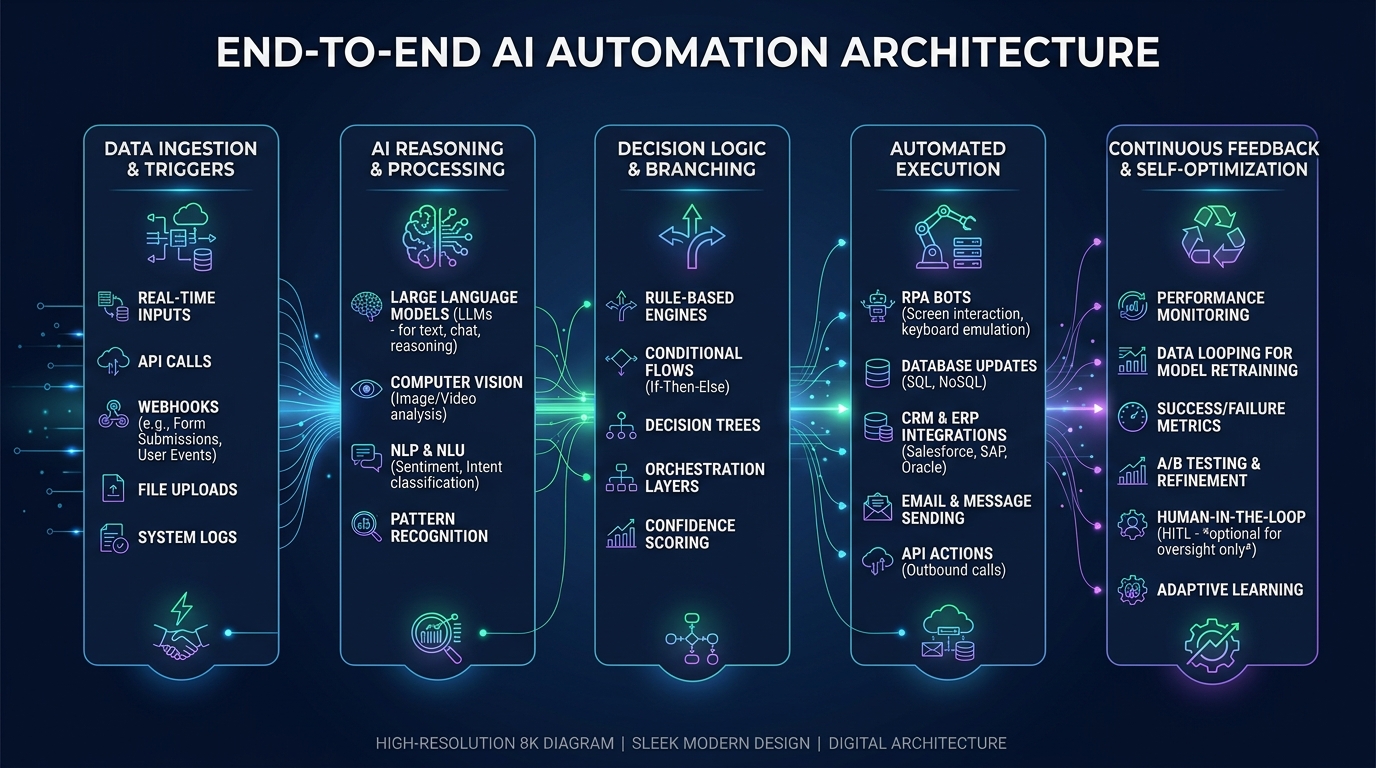
A production-ready enterprise ai automation stack comprises four modular architectural layers working synchronously:
- Perception & Data Ingestion Layer: Captures multimodal inputs—such as scanned PDF invoices, audio customer service calls, incoming webhook payloads, or SQL database change streams—and transforms them into structured JSON schemas.
- Cognitive Reasoning Engine: Powered by foundational Large Language Models (LLMs) and Small Language Models (SLMs). This layer analyzes the extracted data, applies complex business logic rules, verifies compliance, and determines the optimal execution sequence.
- Tool Execution & Orchestration Protocol: Uses Model Context Protocols (MCP), REST APIs, and event buses to interact directly with internal databases, CRM systems, payment gateways, and third-party SaaS applications.
- Verification & Governance Guardrails: Evaluates the generated output against predefined validation schemas, security policies, and confidence thresholds before committing state changes to production databases.
Autonomous AI Agents: The Next Evolution of Workflow Execution
The most transformative frontier in enterprise operations is the deployment of autonomous AI agents within organizational workflows. Instead of manually mapping every possible decision tree, teams deploy specialized agent personas that collaborate to achieve high-level business goals.
For example, in automated software maintenance, a triage agent monitors error telemetry logs, an investigation agent clones the repository to analyze stack traces, a developer agent writes and tests a code fix, and a review agent generates a pull request with complete architectural documentation. As detailed in our analysis of AI trends, multi-agent swarms are rapidly replacing linear, single-threaded batch scripts.
Retrieval-Augmented Generation (RAG) in Automated Data Pipelines
Integrating live corporate memory into automated pipelines is essential to eliminate hallucinations and ground decisions in factual business records. By coupling vector databases with dense semantic search algorithms, automated systems dynamically retrieve contextual snippets from hundreds of thousands of internal policy documents, knowledge base articles, and past customer interaction transcripts.
When an automated workflow processes a client request, the system retrieves only the relevant verified documentation before constructing the LLM prompt. This guarantees that automated decisions remain fully compliant with enterprise standards and current regulatory guidelines.
Human-in-the-Loop (HITL) and Automated Escalation Protocols
While autonomy is the ultimate goal, resilient production architectures incorporate Human-in-the-Loop (HITL) mechanisms to handle low-confidence scenarios, financial transactions above designated thresholds, or sensitive edge cases.
When an automated decision engine calculates a confidence score below acceptable tolerances (e.g., < 95%), the execution state is safely serialized and dispatched to an operations dashboard or Slack channel for manual employee review. Once approved or edited by a human supervisor, the pipeline resumes execution seamlessly.
High-Impact Enterprise Use Cases for Intelligent Automation
Organizations across diverse economic sectors are utilizing ai automation to unlock massive operational efficiencies:
- Autonomous Customer Support Resolution: Intelligent conversational agents resolve up to 70% of inbound customer inquiries—including processing order returns, checking shipment statuses, and resetting credentials—without human intervention.
- Automated Financial Invoice & Expense Processing: Vision transformers parse multi-page vendor invoices, cross-reference purchase orders in ERP databases, and queue approved payments for execution.
- E-Commerce Operations & Dynamic Pricing: Connecting automation pipelines with digital storefronts, as detailed in our what is e-commerce guide, enables automatic catalog enrichment, SEO meta generation, and real-time competitor price tracking.
- Enterprise Knowledge Discovery & RAG: Powering employee query portals with Retrieval-Augmented Generation to instantly surface answers from thousands of internal policy PDFs, technical specifications, and legal contracts.
Step-by-Step Implementation Blueprint: Deploying Scalable Systems
Successfully integrating automated workflows requires a methodical engineering approach rather than ad-hoc experimentation:
- Identify High-Frequency, Low-Variance Workflows: Audit organizational processes to identify repetitive bottlenecks that consume significant employee hours (e.g., lead qualification or document parsing).
- Establish Prompt Engineering & Output Validation Standards: Define strict prompt templates using techniques outlined in our guide on how to use ChatGPT, and enforce Pydantic/Zod structured output schemas.
- Integrate Enterprise Productivity Tools: Connect core applications with the best AI productivity tools to bridge legacy software with modern AI inference APIs.
- Implement Sandboxed Testing & Human-in-the-Loop Reviews: Run automated pipelines in parallel with human operators to evaluate accuracy, verify safety guardrails, and calibrate confidence scoring before full production rollout.
Comparative Technology Matrix: Automation Tools and Frameworks
This technical comparison matrix evaluates prominent ai automation orchestration frameworks across key enterprise criteria:
| Platform / Framework | Primary Paradigm | Target Audience | Key Strengths |
|---|---|---|---|
| LangGraph / CrewAI | Multi-Agent Orchestration | Software Engineers & AI Architects | Complex stateful graphs, cyclical reasoning & sub-agents |
| n8n / Make.com | Visual Node-Based Webhooks | Operations Teams & Developers | Self-hostable, extensive API connectors & AI nodes |
| Zapier Central | No-Code Bot Builder | Small Businesses & Marketers | Instant SaaS integrations & natural language triggers |
| Temporal / Celery | Durable Code Execution | Enterprise Backend Engineers | Fault-tolerant asynchronous tasks & state persistence |
| Custom MCP Servers | Protocol-Based Tool Calling | Full-Stack AI Developers | Standardized tool exposure to frontier LLM clients |
Overcoming Security, Governance, and Error-Handling Challenges
Deploying autonomous systems into production environments presents critical security considerations that technology leaders must address. According to research published on arXiv Artificial Intelligence, automated pipelines are susceptible to prompt injection vulnerabilities, data exfiltration risks, and non-deterministic logic failures.
To maintain enterprise-grade resilience, organizations should enforce strict role-based access control (RBAC) on API credentials, isolate untrusted user inputs with cryptographic sandboxing, and implement immutable audit logging for all automated tool executions as outlined in our what is business technology guide.
Frequently Asked Questions: AI Automation (FAQs)
What is the core difference between AI automation and traditional RPA?
Traditional RPA executes rigid, hardcoded user interface scripts that break when layouts shift. In contrast, ai automation uses cognitive machine learning models to parse unstructured data, understand intent, and make dynamic contextual decisions autonomously.
What tools are best for building automated AI workflows?
For software developers, Python frameworks like LangGraph and CrewAI offer deep customization. For business operations teams, platforms like n8n and Make.com deliver visual node-based integration with popular LLM APIs.
How can companies ensure automated AI workflows remain reliable?
Reliability is achieved through strict JSON schema validation, human-in-the-loop review checkpoints for low-confidence outputs, automated regression testing, and robust fallback error-handling routines.
How does AI automation reduce enterprise operating expenses?
By handling repetitive data entry, customer support ticket triage, and document processing around the clock, automation eliminates operational bottlenecks and frees staff to focus on strategic growth initiatives.
Final Thoughts: The Future of Autonomous Enterprise Operations Beyond 2026
Embracing intelligent ai automation is no longer just an efficiency upgrade; it is the foundational infrastructure for modern business scalability. As reasoning models, tool-use protocols, and agentic swarms continue to mature, the organizations that automate early will achieve unmatched operational agility.
Discover more technology frameworks on our About Us overview, explore our guide on AI in business, and stay tuned to Osmanix for ongoing insights into enterprise automation!