Deploying ai in business has transitioned from an experimental advantage to an indispensable operational requirement for modern enterprises. Companies across financial services, e-commerce, healthcare, and software are leveraging artificial intelligence to automate routine workflows, enhance customer lifetime value, and extract real-time predictive insights from complex datasets.
However, successfully integrating ai in business requires strategic architecture rather than ad-hoc tool adoption. Organizations must align AI initiatives with concrete commercial objectives, clean data governance, and automated integration pipelines.
In this comprehensive enterprise guide on ai in business in 2026, we explore the core transformation pillars, highlight high-ROI use cases, and provide an actionable roadmap for implementing scalable AI solutions.

Why AI in Business Is the Core Driver of Enterprise Value
According to macroeconomic findings published by Statista Global Tech Analytics, enterprise spending on artificial intelligence software and infrastructure will exceed $500 billion annually. Implementing ai in business enables companies to reduce operational costs by up to 35% while dramatically accelerating product delivery cycles.
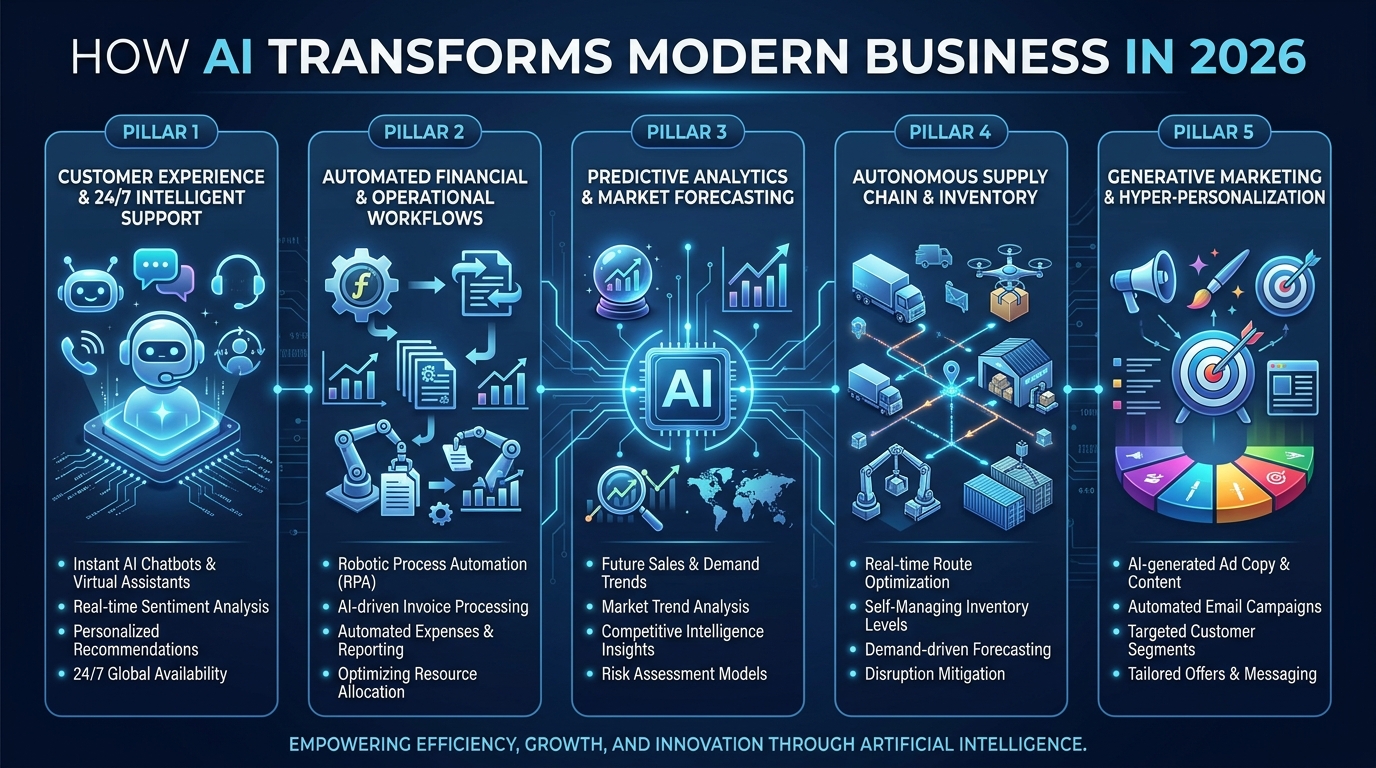
The 5 Core Pillars of AI Transformation in Modern Companies
- 1. 24/7 Intelligent Customer Support: Multimodal conversational agents resolve up to 80% of customer tickets instantly with real-time sentiment tracking.
- 2. Automated Financial & Back-Office Workflows: Robotic process automation (RPA) combined with LLMs eliminates manual invoice processing and audit compliance lag.
- 3. Predictive Analytics & Market Forecasting: Machine learning algorithms identify buying patterns and supply bottlenecks before they disrupt operations.
- 4. Autonomous Supply Chain Management: Dynamic inventory balancing deployed across global hubs as detailed in our what is e-commerce guide.
- 5. Hyper-Personalized Marketing Campaigns: Real-time ad copy generation and customer segmentation explained in our digital marketing strategy guide.
Strategic Matrix: AI in Business ROI by Functional Area
| Business Department | AI Integration | Cost Reduction | Revenue Multiplier |
|---|---|---|---|
| Customer Support | Autonomous Conversational Agents | 45% Lower Support Overhead | +25% Customer Retention |
| Software Engineering | AI Coding Co-Pilots | 50% Faster Feature Delivery | Accelerated Product Time-to-Market |
| Sales & Marketing | Predictive Lead Scoring & Copy | 30% Lower CAC | +40% Pipeline Conversion Rate |
| Finance & Operations | Automated Auditing & Reconciliation | 60% Reduction in Processing Errors | Streamlined Cash Flow Velocity |
Frequently Asked Questions: AI in Business (FAQs)
How can small businesses adopt AI cost-effectively?
Small businesses can leverage off-the-shelf software reviewed in our best AI productivity tools guide without building expensive custom models from scratch.
What infrastructure is required for enterprise AI integration?
Enterprises require cloud data pipelines and modern IT infrastructure outlined in our what is business technology guide to connect ERP systems with AI models.
Summary & Key Takeaways: Scaling Enterprise Intelligence
Strategic adoption of ai in business enables companies to establish insurmountable competitive moats, streamline operations, and drive exponential commercial growth.
Discover more digital transformation blueprints on our About Us overview and subscribe to our newsletter for weekly enterprise insights!