The consumer electronics ecosystem is undergoing a generational paradigm shift in 2026. For over two decades, the smartphone served as the indisputable nucleus of digital life, anchoring accessories like smartwatches, fitness trackers, and Bluetooth headsets into secondary satellite roles. Today, next-generation AI gadgets—led by augmented reality smart glasses, neural-powered voice earbuds, and context-aware wearable pins—are breaking free from screen-bound computing, creating an ambient intelligence layer that hears, sees, analyzes, and responds to human surroundings in real time.
However, empowering wearable hardware with multimodal computer vision, directional far-field microphones, and cloud-connected large language models (LLMs) creates profound challenges regarding consumer data privacy, passive public surveillance, and biometric consent. As technology giants and hardware startups compete to define post-smartphone computing, the defining battle of the 2026 tech landscape will not merely be fought on silicon efficiency or display resolution—it will be decided by user trust and zero-knowledge privacy architecture.
Table of Contents
Table of Contents
- The Evolution of AI Gadgets: Moving Beyond Smartphone Screens
- Smart Glasses: The Leading Frontier in Ambient Computer Vision
- AI Earbuds: Transforming Audio into Real-Time Productivity & Translation
- Comparison Matrix: AI Gadget Categories, Specs, and Privacy Posture
- The Privacy Paradox: Constant Telemetry vs. User Consent
- Edge AI Hardware: Why On-Device Neural Processing Is the Future
- Smart Buyer Checklist: What to Evaluate Before Purchasing AI Gadgets
- Frequently Asked Questions About AI Gadgets
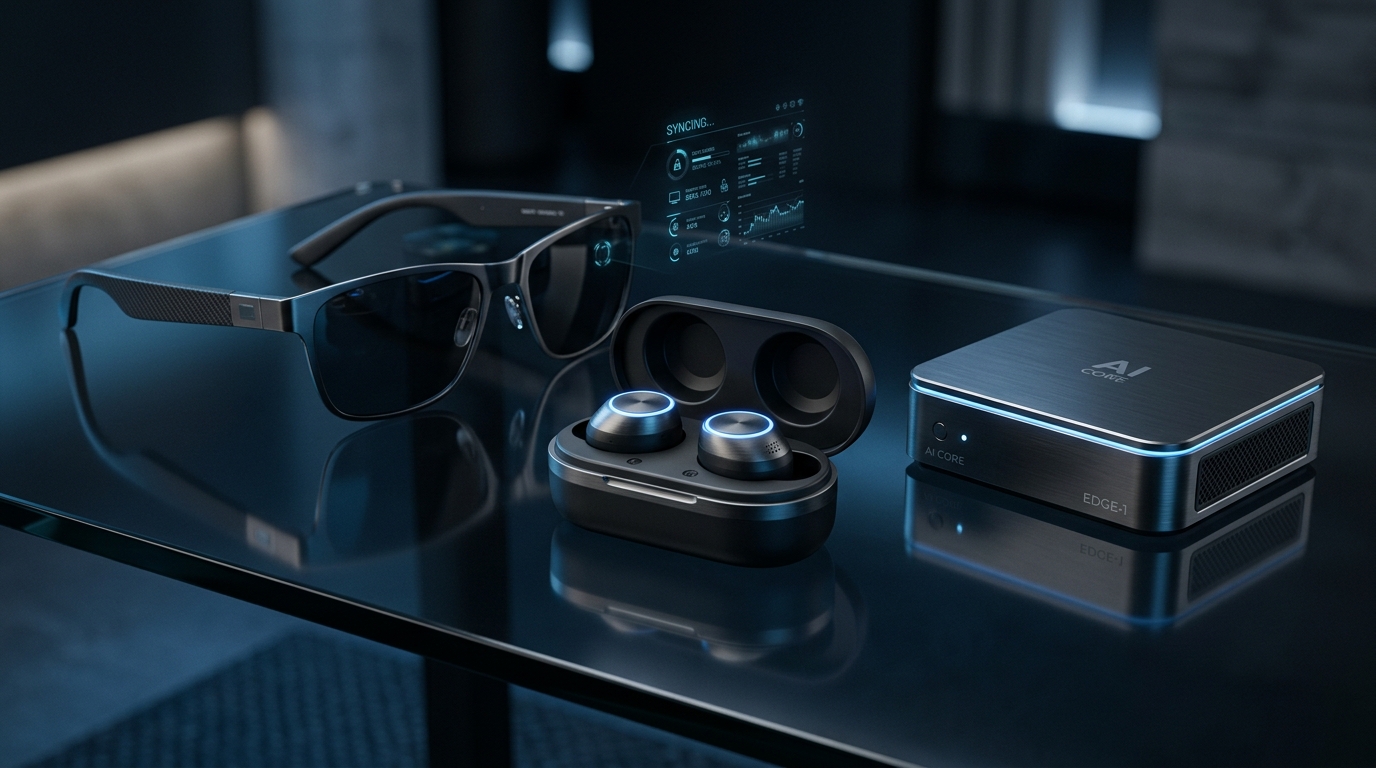
The Evolution of AI Gadgets: Moving Beyond Smartphone Screens
Over the past fifteen years, digital communication required users to continually look down at a handheld glass display. While smartphones pack immense compute, they demand conscious visual attention, fragmented app navigation, and manual typing. Modern AI gadgets represent a fundamental departure toward “calm technology”—computing that resides in the periphery of consciousness, ready to assist through conversational natural language, spatial audio, and heads-up contextual visual cues.
Recent industry research from Reuters and consumer technology showcases such as IFA demonstrate that hardware developers are aggressively pivoting toward specialized multimodal form factors. Rather than asking users to launch an application, modern AI gadgets maintain low-power awareness of ambient context, enabling seamless workflows such as simultaneous foreign language translation, meeting transcription, and environmental object recognition.
Smart Glasses: The Leading Frontier in Ambient Computer Vision
Among all wearable categories, smart glasses have emerged as the most promising hardware interface. Because eyewear occupies a permanent position at eye level, it uniquely aligns machine perception with human perspective:
- First-Person Computer Vision: Equipped with ultra-compact cameras and vision-language models, smart glasses can identify landmarks, read printed text, inspect nutrition labels, and diagnose technical machinery in real time.
- Directional Open-Ear Audio: Micro-speakers embedded in the temple arms deliver discrete audio guidance, GPS navigation, and AI assistant answers without obstructing environmental awareness.
- Camera-Free Audio Eyewear: In response to corporate and public privacy concerns, several manufacturers are introducing camera-free AI glasses that offer rich voice intelligence and spatial acoustics without optics, making them universally permissible in sensitive enterprise and healthcare environments.
Industry analyses from publications like TechCrunch indicate that mainstream consumer adoption will accelerate as waveguide optics and Micro-OLED displays shrink into standard lightweight acetate frames indistinguishable from prescription eyewear.
AI Earbuds: Transforming Audio into Real-Time Productivity & Translation
Wireless earbuds have expanded far beyond streaming music and handling teleconferences. Modern AI earbuds are engineered as dedicated personal productivity companions:
- Real-Time Cross-Lingual Translation: Simultaneous bidirectional interpretation allows two individuals speaking different languages to hold fluent conversations with sub-second latency.
- Intelligent Meeting Summarization: Dedicated onboard recording engines (such as the Plaud One ecosystem) capture conversations, eliminate background noise, and automatically synthesize structured action items and meeting transcripts.
- Active Voice Isolation: Advanced neural beamforming filters out ambient acoustic chaos, ensuring voice commands are accurately captured even in crowded transit hubs.
For additional digital efficiency tools, creators and professionals can leverage our companion utilities in the Osmanix Tools Directory, including our Text Tools Suite and Developer Utilities.
Comparison Matrix: AI Gadget Categories, Specs, and Privacy Posture
The following technical reference matrix compares the four primary consumer AI hardware categories across processing architecture, battery life, primary sensor arrays, and privacy risk levels:
| AI Gadget Form Factor | Primary Interface | Typical Battery Life | Compute Architecture | Privacy Risk Level | Recommended 2026 Use Case |
|---|---|---|---|---|---|
| Smart Glasses (Camera) | Visual HUD / Microphones / Optics | 4 – 8 Hours (Charging Case) | Hybrid Edge + Cloud LLM | High (Passive visual recording) | Navigation, Visual AI, Field Engineering |
| Smart Glasses (Audio-Only) | Open-Ear Speakers / Mic Array | 12 – 16 Hours | Local DSP + Cloud Voice | Low – Moderate (Voice only) | Office Meetings, Podcasts, Commuting |
| AI Earbuds | In-Ear Spatial Audio / Voice Control | 6 – 10 Hours Active | Dedicated Neural NPU | Moderate (Conversation capture) | Live Translation, Note Taking, Calls |
| Wearable AI Pins / Pendants | Voice / Laser Projection / Mic | 3 – 5 Hours | Cloud-Heavy LLM Pipeline | High (Continuous ambient listening) | Executive Productivity, Lifelogging |
The Privacy Paradox: Constant Telemetry vs. User Consent
The core dilemma of ambient AI gadgets lies in data telemetry: the more environmental context an artificial intelligence system ingests, the more helpful its contextual suggestions become. However, continuous sensory capture introduces critical civil liberties and digital privacy dilemmas:
- Third-Party Bystander Consent: A wearer wearing smart glasses or recording earbuds in a coffee shop or meeting room may inadvertently capture biometric data, facial geometry, and private conversations of bystanders who never provided consent. Organizations like the Electronic Frontier Foundation (EFF) actively advocate for transparent, hardware-level recording indicators.
- Cloud Data Retention and Model Training: Cloud-reliant AI devices transmit audio and video streams to remote server farms. Consumers must scrutinize manufacturer policies to verify whether raw telemetry is retained, encrypted, or utilized to train proprietary foundation models.
- Physical Recording Tally Lights: To prevent covert surveillance, regulatory bodies in the European Union and North America increasingly mandate tamper-proof LED indicators that clearly illuminate whenever sensor arrays are active.
To safeguard your personal credentials and online infrastructure across connected devices, explore our guide on Cryptographic Password Security and UTM Link Privacy.
Edge AI Hardware: Why On-Device Neural Processing Is the Future
To resolve the tension between capability and confidentiality, the semiconductor industry is investing heavily in ultra-low-power Neural Processing Units (NPUs) capable of running quantized small language models (SLMs) locally on wearable silicon:
- Zero-Latency Execution: Local inference executes in milliseconds without waiting for roundtrip cellular or Wi-Fi handshake latency.
- Offline Availability: Essential functions like transcription, voice commands, and navigation operate seamlessly in airplane mode or remote geographic regions.
- Guaranteed Data Isolation: Voice vectors and camera frames never leave the device hardware perimeter, eliminating risks of interception or cloud database breaches in compliance with NIST Cybersecurity Standards.
Smart Buyer Checklist: What to Evaluate Before Purchasing AI Gadgets
Before investing in new AI wearables, consumers and technology buyers should evaluate the following critical checkpoints:
- Data Ownership & Export: Ensure the manufacturer provides clear data export and 1-click cloud deletion mechanisms for all transcripts and logs.
- Subscription Models: Verify whether advanced AI features (e.g., unlimited translation or meeting summaries) require recurring monthly cloud subscription fees.
- Physical Mute Switches: Look for physical hardware disconnect switches for microphones and cameras rather than software-only toggles.
- Ecosystem Interoperability: Confirm whether the gadget integrates seamlessly with iOS, Android, macOS, and Windows workstations.
Frequently Asked Questions About AI Gadgets
Here are concise answers to common questions regarding AI gadgets, smart glasses, wireless earbuds, and data privacy safeguards: