Understanding microsoft azure is vital for software engineers, enterprise IT architects, and technology leaders modernizing legacy infrastructure for the cloud era. As one of the world’s foremost hyperscale cloud platforms, Microsoft’s global cloud infrastructure powers critical public sector systems, Fortune 500 enterprises, and fast-scaling digital applications worldwide.
What makes microsoft azure unique among cloud providers is its native integration with the Microsoft enterprise ecosystem—seamlessly uniting Windows Server, Active Directory, SQL Server, and Microsoft 365 with modern cloud-native microservices and distributed computing services.
According to technical documentation from Microsoft Azure Official Documentation, the platform spans hundreds of distributed datacenters across more global regions than any other cloud provider. In this comprehensive architecture guide, we dissect the core compute engines, managed databases, global networking, identity governance with Entra ID, and artificial intelligence capabilities that define microsoft azure.

What Is Microsoft Azure and How Does It Work?
At its architectural foundation, microsoft azure provides on-demand access to virtualized computing hardware, high-throughput storage systems, software-defined networking, and managed application runtimes over the internet. This model eliminates the immense capital expenditure of purchasing physical server hardware, operating private data centers, and paying continuous cooling and facility costs, aligning directly with modern cloud computing principles.
In cloud management, resources are structured systematically into Management Groups, Subscriptions, and Resource Groups. A Resource Group acts as a logical container holding related resources—such as virtual machines, virtual networks, and databases—allowing administrators to deploy, update, monitor, and delete entire application tiers as a single lifecycle unit.
Underneath the management layer, Azure Resource Manager (ARM) coordinates all provisioning requests, applying role-based access policies, billing tags, and compliance locks consistently across programmatic CLI commands, portal actions, and automated deployment pipelines.
Azure Core Compute: Virtual Machines, App Service, and AKS
The compute layer in microsoft azure delivers diverse execution models ranging from raw infrastructure virtual machines to managed container orchestration:
- Azure Virtual Machines (IaaS): Provides scalable on-demand Linux and Windows Server compute instances with custom CPU, RAM, and GPU configurations for legacy enterprise migrations and custom batch workloads.
- Azure App Service (PaaS): A fully managed platform for building, deploying, and auto-scaling web applications and REST APIs in .NET, Java, Node.js, Python, and PHP without managing underlying server operating systems.
- Azure Kubernetes Service (AKS): A production-grade managed container runtime designed according to Azure Kubernetes Service (AKS) Architecture. AKS automates provisioning, upgrading, and horizontal scaling of container clusters, fully integrated with Kubernetes container orchestration and Docker containerization.
- Azure Container Apps: A serverless container platform built on Kubernetes and KEDA, enabling microservices to scale dynamically to zero based on incoming HTTP traffic or queue message volume.
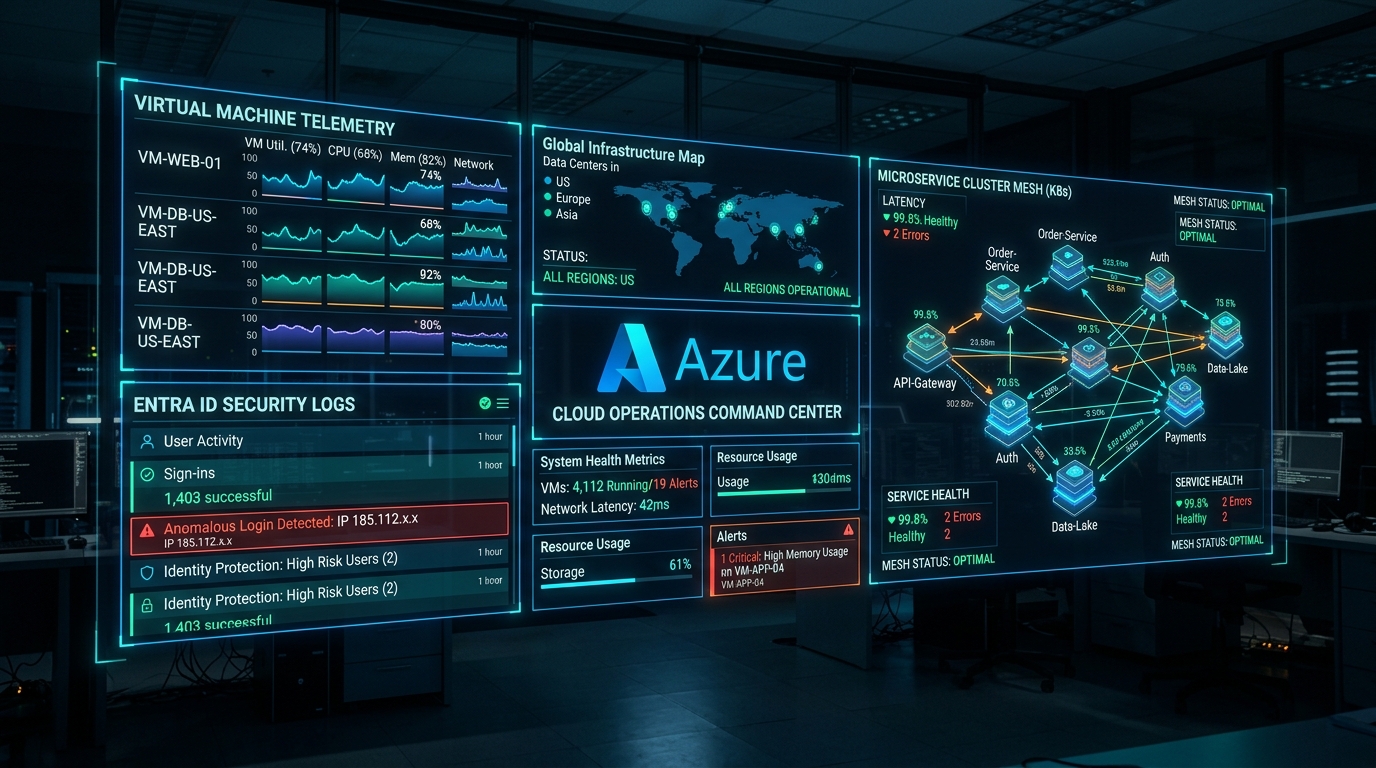
Enterprise Storage and Managed Databases: Blob, Azure SQL, and Cosmos DB
Data resilience in cloud environments is managed across specialized storage tiers designed for unstructured files, enterprise file shares, and globally distributed databases:
- Azure Blob Storage: Highly scalable object storage for unstructured media files, backups, and massive big data lakes, featuring Hot, Cool, Cold, and Archive access tiers for cost efficiency.
- Azure Files: Fully managed cloud file shares accessible via industry-standard SMB and NFS protocols, enabling seamless hybrid mounting to on-premise Windows and Linux servers.
- Azure SQL Database: An intelligent, fully managed relational database engine that handles patching, backups, replication, and high-availability failover automatically with 99.995% uptime guarantees.
- Azure Cosmos DB: A globally distributed, multi-model NoSQL database delivering single-digit millisecond latency SLAs with turnkey multi-region replication and multi-master write capabilities.
Global Networking: Virtual Networks (VNet) and ExpressRoute
The network backbone connects cloud resources through private software-defined networks. Using Azure Virtual Networks (VNet), organizations configure private IP address spaces, create isolated subnets, and attach Network Security Groups (NSGs) for granular packet filtering.
For enterprise hybrid connectivity, Azure ExpressRoute creates dedicated, private, high-speed fiber connections between on-premise corporate data centers and cloud regions without routing traffic over the public internet, ensuring maximum throughput and minimal latency.
Identity and Access Governance with Microsoft Entra ID
Security and identity governance are managed centrally through Microsoft Entra ID (formerly Azure Active Directory). Entra ID serves as the central identity provider for cloud authentication, Single Sign-On (SSO), and Multi-Factor Authentication (MFA).
Through Azure Role-Based Access Control (RBAC), administrators assign least-privilege permissions across subscriptions and resource groups, ensuring fine-grained access boundaries for developers and automated service principals.
Serverless Computing with Azure Functions and Event Grid
Event-driven execution in microsoft azure allows engineering teams to execute discrete backend logic without managing persistent virtual servers:
- Azure Functions: Serverless compute service supporting C#, Python, JavaScript, TypeScript, and Java that executes code in response to HTTP requests, database modifications, or message queues.
- Azure Event Grid: A fully managed event routing service that connects disparate application events across cloud microservices with sub-second delivery latency.
- Azure Logic Apps: Low-code workflow automation orchestrating integration workflows across enterprise SaaS applications and cloud APIs.
Enterprise Artificial Intelligence and Azure OpenAI Service
In the generative AI revolution, microsoft azure stands as a primary enterprise computing partner. Through Azure OpenAI Service, enterprises securely deploy established large language models (such as GPT-4o) within private enterprise security perimeters with strict data residency, private networking, and zero public data retention.
Combined with Azure AI Search for high-accuracy Retrieval-Augmented Generation (RAG) and Azure Machine Learning for custom model fine-tuning, organizations construct resilient enterprise AI pipelines.
DevOps Automation and Infrastructure as Code (Bicep and Terraform)
Modern cloud infrastructure is managed through declarative code rather than manual portal clicking. Teams utilize Bicep (Azure-native domain-specific language) and HashiCorp Terraform to define repeatable infrastructure blueprints.
Coupled with modern DevOps methodology and automated CI/CD delivery pipelines in Azure DevOps or GitHub Actions, teams achieve rapid, automated, and audited deployments across multi-environment staging clusters.
Hybrid Cloud Architecture with Azure Arc and Azure Stack
For organizations operating hybrid infrastructure, Azure Arc extends cloud management capabilities, compliance policies, and data services across on-premise data centers, edge computing hardware, and multi-cloud environments (including AWS and GCP). IT teams can govern bare-metal Linux servers and external Kubernetes clusters using the identical Azure portal controls and ARM templates.
Comparative Architectural Matrix: Azure vs. AWS vs. GCP
Understanding how microsoft azure compares with peer hyperscalers like Amazon Web Services (AWS) and Google Cloud Platform (GCP) clarifies multi-cloud architectural choices:
| Core Service Category | Microsoft Azure | Amazon Web Services (AWS) | Google Cloud Platform (GCP) |
|---|---|---|---|
| Virtual Compute (IaaS) | Azure Virtual Machines | Amazon EC2 | Compute Engine |
| Container Orchestration | Azure Kubernetes Service (AKS) | Amazon EKS | Google Kubernetes Engine (GKE) |
| Serverless Compute | Azure Functions | AWS Lambda | Cloud Functions / Cloud Run |
| Object Storage | Azure Blob Storage | Amazon S3 | Cloud Storage |
| Managed Relational DB | Azure SQL Database | Amazon RDS / Aurora | Cloud SQL / Cloud Spanner |
| Identity Governance | Microsoft Entra ID | AWS IAM | Cloud IAM |
| Hybrid Integration | Azure Arc / ExpressRoute | AWS Outposts / Direct Connect | Google Distributed Cloud / Interconnect |
Cloud Security, Compliance, and Microsoft Defender for Cloud
Enterprise cloud security is continuously monitored through Microsoft Defender for Cloud and Microsoft Sentinel (Cloud SIEM). Defender provides Cloud Security Posture Management (CSPM) and Cloud Workload Protection (CWP), identifying misconfigurations, enforcing regulatory compliance standards (SOC 2, ISO 27001, HIPAA), and automatically blocking anomalous network attacks.
Frequently Asked Questions: Microsoft Azure (FAQs)
What is Microsoft Azure primarily used for?
Microsoft Azure is primarily used by organizations to host web applications, deploy containerized microservices, manage relational and NoSQL databases, build hybrid enterprise networks, and integrate advanced AI capabilities into corporate software.
How does Microsoft Azure compare to AWS and GCP?
Azure offers deep native synergy with Microsoft enterprise tools (Windows Server, SQL Server, Active Directory, Office 365), making it the premier choice for corporate enterprises and hybrid cloud architectures compared to AWS or GCP.
What is Microsoft Entra ID in Azure?
Microsoft Entra ID (formerly Azure Active Directory) is the cloud-based identity and access management solution that secures user logins, controls RBAC permissions, and provides Single Sign-On across cloud applications.
How does Azure support hybrid cloud environments?
Through Azure Arc, Azure Stack, and Azure ExpressRoute, organizations can manage on-premise servers and multi-cloud Kubernetes clusters directly from the centralized Azure management portal.
Summary & Key Takeaways: Architecting Enterprise Workloads on Azure
Mastering microsoft azure unlocks unmatched scalability, hybrid cloud flexibility, and enterprise-grade security for modern IT engineering. By combining compute agility with automated compliance and state-of-the-art AI infrastructure, the platform provides a comprehensive foundation for mission-critical software.
To explore more expert cloud architecture breakdowns, visit our About Us page and explore our full repository of cloud computing and DevOps guides.