Understanding what is kubernetes has become a fundamental milestone for software engineers, DevOps practitioners, and cloud architects running mission-critical applications at global scale. Modern cloud-native software is rarely built as a single monolithic block; instead, organizations decompose systems into dozens or hundreds of containerized microservices running across distributed servers.
When managing enterprise workloads, manual server administration and individual container restarts quickly become impossible. What is kubernetes at its core? It is a production-grade open-source container orchestration engine that automates the deployment, horizontal scaling, networking, and self-healing lifecycle of containerized workloads.
Originally designed by Google engineers based on their internal Borg cluster management system and maintained by the Cloud Native Computing Foundation (CNCF), Kubernetes coordinates clusters of compute nodes so they function as a unified, fault-tolerant supercomputer. In this comprehensive technical guide, we break down cluster architecture, control plane mechanics, pod orchestration, networking fabrics, and production deployment strategies.

What Is Kubernetes and How Does It Work?
To clearly explain what is kubernetes, we must look at how modern applications are packaged and executed. Rather than bundling software with full guest operating systems inside heavy virtual machines, developers encapsulate binaries, dependencies, and configurations into lightweight container images using containerization principles in Docker.
While running single containers on a single developer workstation is straightforward, orchestrating thousands of microservice containers across hundreds of cloud virtual machines requires continuous coordination. According to technical documentation from Kubernetes Official Documentation, Kubernetes operates on a declarative configuration model. Engineers define the “desired state” of their infrastructure using YAML manifests, and Kubernetes controllers continuously reconcile actual infrastructure state to match that declaration.
If a physical server suffers a power failure, Kubernetes detects the unavailable pods and immediately schedules identical replacement containers on healthy worker nodes without human intervention. This automated operational paradigm forms the foundation of modern cloud computing architecture.
The Kubernetes Control Plane Architecture
The central brain of a Kubernetes cluster is the Control Plane (formerly known as master nodes). The Control Plane manages cluster state, processes administrative API commands, evaluates resource constraints, and makes global scheduling decisions:
- kube-apiserver: The front-end REST API gateway that exposes all Kubernetes operations. Every administrative CLI tool (such as kubectl), worker node daemon, and dashboard communicates exclusively through the API server.
- etcd: A distributed, consistent, and highly available key-value store that serves as the cluster’s single source of truth, storing all configuration specs, secrets, and real-time state telemetry.
- kube-scheduler: Analyzes unscheduled pods, evaluates worker node resource capacities (CPU, RAM, GPU), affinity rules, and taints/tolerations to select the optimal host machine.
- kube-controller-manager: Runs core background control loops (Node Controller, Replication Controller, EndpointSlice Controller) that continuously monitor cluster state and drive remediation.
- cloud-controller-manager: Bridges Kubernetes with underlying cloud provider APIs on platforms like Google Cloud Platform (GKE) and Amazon Web Services (EKS) for managed load balancers and storage volumes.
Worker Nodes: Kubelet, Kube-Proxy, and Container Runtime
Worker nodes represent the physical or virtual computing power where application containers actually run. When understanding what is kubernetes execution flow, every worker node contains three fundamental components:
1. Kubelet: An essential node agent running on every machine that registers the node with the API server, receives PodSpecs, and instructs the container runtime to start or stop container processes while performing liveness and readiness health checks.
2. Container Runtime: The software responsible for pulling container images, executing namespaces, and managing cgroups. Kubernetes utilizes CRI-compliant runtimes such as containerd and CRI-O.
3. Kube-Proxy: A network proxy that maintains IP tables and IPVS routing rules on each node, handling internal network communication and packet forwarding across cluster services.
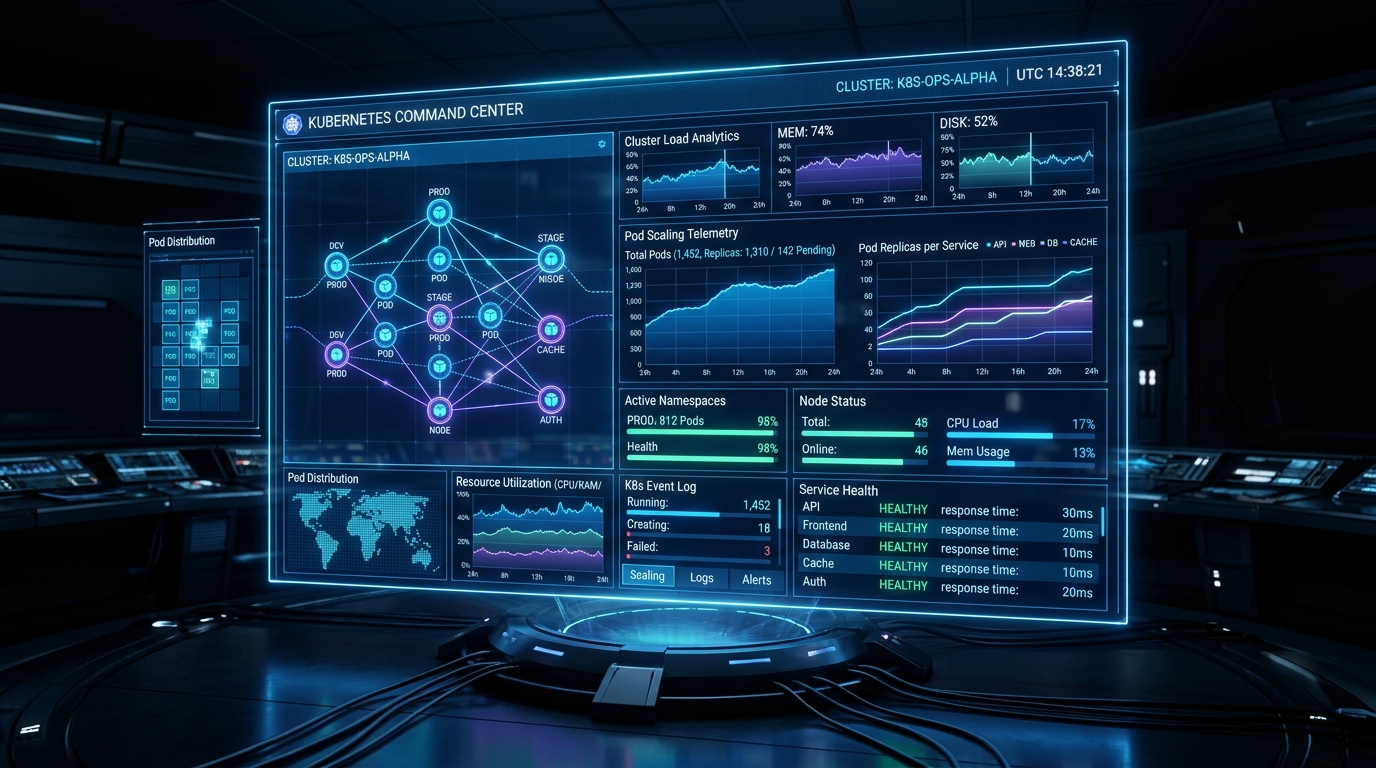
Core Kubernetes Objects: Pods, Deployments, and Services
Kubernetes abstracts low-level infrastructure through declarative API resources that represent your application components:
- Pods: The smallest deployable computing unit in Kubernetes. A Pod encapsulates one or more closely coupled containers sharing the same network namespace (IP address and port space) and storage volumes.
- Deployments: Declarative objects that describe the desired state for stateless applications. Deployments manage ReplicaSets, orchestrate zero-downtime rolling updates, and enable instant rollbacks to previous versions.
- StatefulSets: Designed specifically for stateful workloads like distributed databases (PostgreSQL, Cassandra, Redis clusters) that require unique network identifiers and persistent storage bindings.
- DaemonSets: Ensures an exact copy of a specific pod runs across all (or designated) worker nodes, commonly used for log collection (Fluentd) and metric monitoring daemons (Prometheus Node Exporter).
- Services: An abstraction layer providing a stable IP address and DNS hostname for an ephemeral, dynamic pool of pods, routing traffic reliably across backend instances.
Kubernetes Networking and Ingress Controllers
In Kubernetes, every pod receives its own unique routable IP address within the cluster network (the IP-per-Pod model). Containers within the same Pod communicate via localhost, while pods communicate across worker nodes without requiring Network Address Translation (NAT).
Container Network Interface (CNI) plugins such as Calico, Cilium (eBPF-powered), and Flannel manage pod IP allocation and cross-node packet encapsulation. For external traffic routing, Kubernetes utilizes Ingress Controllers (such as NGINX Ingress or Traefik) and modern Gateway API specifications to provide HTTP/HTTPS routing, SSL/TLS termination, path-based routing, and global load balancing.
Automated Pod Scaling and Self-Healing Resilience
One of the primary answers to what is kubernetes value in production is automated elasticity. Kubernetes handles dynamic application demand through multi-layered scaling engines:
- Horizontal Pod Autoscaler (HPA): Automatically adjusts the number of pod replicas based on CPU utilization, memory consumption, or custom Prometheus application metrics.
- Vertical Pod Autoscaler (VPA): Automatically resizes CPU and memory resource requests and limits for running containers over time based on historical usage analysis.
- Cluster Autoscaler / Karpenter: Automatically provisions new cloud worker nodes when pending pods exceed cluster capacity and drains idle nodes to minimize infrastructure spend.
- Self-Healing Probes: Kubelet uses Liveness Probes to restart stalled containers, Readiness Probes to stop traffic to unready pods, and Startup Probes to protect slow-booting legacy apps.
Storage Orchestration with Persistent Volumes and CSI
Because containers have ephemeral root filesystems that are wiped when restarted, stateful applications require decoupled storage architecture. Kubernetes solves this with Persistent Volumes (PV) and Persistent Volume Claims (PVC).
Through the Container Storage Interface (CSI), Kubernetes dynamically provisions cloud block storage (such as AWS EBS, Google Cloud Persistent Disks, or Azure Managed Disks) or networked file shares (NFS, Ceph) and attaches them seamlessly to pods as they migrate across physical cluster nodes.
Configuration and Secrets Management in Kubernetes
Following 12-Factor App methodology, application code must remain strictly decoupled from environment-specific configuration parameters and credentials:
- ConfigMaps: Store non-confidential configuration key-value pairs, JSON files, or server configurations that can be injected into pods as environment variables, command-line arguments, or mounted configuration files.
- Secrets: Store sensitive credentials such as database passwords, API access tokens, and SSH keys. Secrets are stored in base64 format in etcd (and can be encrypted at rest with KMS integration) or synchronized dynamically via External Secrets Operator from HashiCorp Vault or AWS Secrets Manager.
Integrating Kubernetes into Modern DevOps and CI/CD Pipelines
Kubernetes serves as the foundational deployment runtime for contemporary DevOps methodology and automated continuous delivery. In a modern GitOps workflow (utilizing tools like ArgoCD or Flux), the Git repository acts as the single declarative source of truth for all Kubernetes manifests.
When developers push code changes, automated CI/CD pipeline automation builds Docker images, runs automated integration tests, updates the image tag in the Git repository, and GitOps controllers automatically synchronize the live cluster state without requiring manual developer access to production clusters.
Comparative Matrix: Kubernetes vs. Docker Swarm vs. Traditional VMs
The following architectural matrix outlines key technical differences between major application deployment and container orchestration approaches:
| Capability | Kubernetes (K8s) | Docker Swarm | Traditional Virtual Machines |
|---|---|---|---|
| Architecture Focus | Enterprise Distributed Orchestration | Lightweight Container Clustering | Full Hardware Virtualization |
| Scalability Limit | Up to 5,000 Nodes & 150,000 Pods | Up to 1,000 Nodes | Limited by Hypervisor Hardware |
| Self-Healing | Advanced Automated Probes & Rescheduling | Basic Container Restarts | Manual / Hypervisor Failover |
| Ecosystem & Extensibility | Massive (CRDs, Operators, CNCF) | Moderate (Docker Native) | Vendor Specific (VMware, KVM) |
| Learning Curve | Steep / Advanced | Low / Simple | Moderate |
| Multi-Cloud Portability | Universal (GKE, EKS, AKS, On-Prem) | Docker-Compatible Hosts | Complex Hypervisor Conversions |
Cluster Security, RBAC, and Network Policies
Securing enterprise Kubernetes clusters requires defense-in-depth across multiple operational layers:
- Role-Based Access Control (RBAC): Enforces least-privilege principles by binding Roles and ClusterRoles to specific Users, ServiceAccounts, and Groups.
- Network Policies: Acts as an internal cluster firewall, enforcing granular microsegmentation so that compromised pods cannot communicate with sensitive database pods.
- Admission Controllers: Tools like Open Policy Agent (OPA) Gatekeeper and Kyverno validate and mutate API requests, blocking unprivileged containers running as root.
- Secrets Encryption & Ephemeral Service Tokens: Safeguards sensitive tokens and continuously rotates credentials to maintain zero-trust security postures.
Frequently Asked Questions: Kubernetes (FAQs)
What is the primary purpose of Kubernetes?
The primary purpose of Kubernetes is to automate the deployment, scaling, health monitoring, and networking of containerized applications across clusters of servers, ensuring continuous availability and zero-downtime operations.
What is the difference between Docker and Kubernetes?
Docker is a containerization technology used to package application code into container images, whereas Kubernetes is a container orchestration platform designed to run, manage, scale, and coordinate millions of Docker container instances across distributed clusters.
How does Kubernetes manage container failover?
When a container crashes or a worker node goes offline, Kubernetes detects the discrepancy between the declared desired state and the live cluster state. The control plane automatically reschedules replacement pods on healthy nodes and updates network routes instantaneously.
Can Kubernetes run on any cloud provider?
Yes. Kubernetes provides universal abstraction across Google Cloud (GKE), AWS (EKS), Microsoft Azure (AKS), private data centers (OpenShift, Rancher), and edge devices (K3s), eliminating vendor lock-in for modern engineering teams.
Summary & Key Takeaways: Mastering Kubernetes Orchestration
Mastering what is kubernetes represents the gold standard for engineering resilience, scalability, and efficiency in modern enterprise software. By abstracting raw infrastructure into declarative, self-healing, and automatically scalable clusters, Kubernetes enables teams to ship code faster and maintain continuous 99.99% service availability.
To explore more comprehensive cloud architecture and engineering blueprints, check our About Us overview and deep-dive into our guides on containerization and cloud infrastructure.