The consumer technology landscape across the Gulf Cooperation Council (GCC) represents one of the world’s most affluent, connected, and rapidly expanding digital arenas. Modern smartphones have evolved far beyond communication devices, serving as indispensable platforms for mobile banking, government digital services, luxury retail, high-definition entertainment, and AI-assisted workflows. Analyzing the gcc smartphone operating system market reveals fascinating commercial dynamics, where Google’s open-source Android and Apple’s closed iOS ecosystem engage in an intense battle for regional dominance.
While global statistics often portray a standardized duopoly, the Gulf region demonstrates distinct consumer patterns shaped by high disposable income, diverse expatriate demographics, aggressive telecom subsidies, and nationwide 5G infrastructure. In this comprehensive industry analysis, we examine the fundamental drivers, market share distribution, and future growth trajectories defining the mobile computing ecosystem across the Gulf states.
Table of Contents
Understanding the GCC Smartphone Operating System Market
The regional mobile sector encompasses mobile OS adoption and device shipments across six key Gulf nations: the United Arab Emirates (UAE), Saudi Arabia (KSA), Qatar, Kuwait, Bahrain, and Oman. According to industry intelligence from Omdia Research, the Middle East smartphone market (excluding Turkey) records annual shipments exceeding 54.8 million devices, with premium revenue concentrated heavily within GCC borders.
Unlike mature Western markets where carrier locks and contract upgrades dominate, or emerging Asian economies centered primarily around budget tiering, the Gulf presents a multi-tiered ecosystem. Premium flagship devices from Apple and Samsung coexist alongside feature-packed mid-range offerings from Xiaomi, HONOR, and Transsion. Understanding this environment requires exploring how hardware and software architectures collaborate, as outlined in our foundational guide on technology for beginners.
Regional Market Dynamics: UAE vs Saudi Arabia
While the GCC is often categorized as a uniform geopolitical bloc, mobile operating system preferences vary substantially between member nations:
Android vs iOS Adoption in the UAE
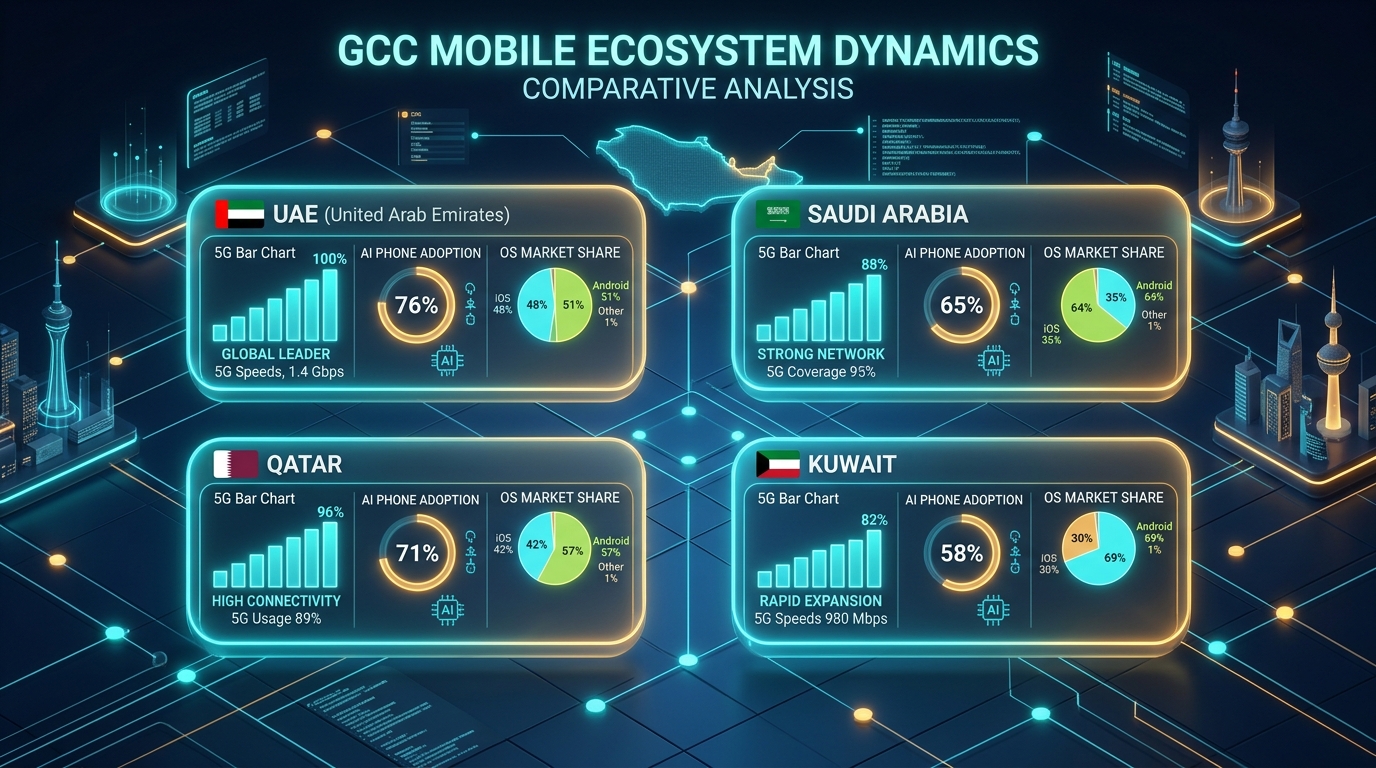
The United Arab Emirates represents one of Apple’s strongest global strongholds. Market telemetry from Statista Global Data indicates that iOS commands approximately 48% to 51% of active mobile traffic in the UAE, creating a near 50-50 parity with Android. This high iOS penetration is driven by high per-capita GDP, early adoption of premium electronics, robust Apple retail presence in Dubai and Abu Dhabi, and attractive carrier installment plans such as those explored in our iPhone UAE payment plans guide.
Saudi Arabia Mobile Market Dynamics
In contrast, the Kingdom of Saudi Arabia (KSA)—the largest market by population and total unit volume—exhibits a clear Android majority. Android accounts for roughly 64% to 66% of active smartphones in the Kingdom, with iOS capturing approximately 34% to 36%. While Saudi Arabia boasts a vast and loyal iPhone user base among youth and corporate professionals, the sheer demographic breadth across Riyadh, Jeddah, Dammam, and regional provinces sustains massive demand for affordable and mid-range Android hardware.
Mobile OS Distribution in Qatar, Kuwait, Bahrain, and Oman
Qatar and Kuwait mirror the UAE’s high-income profile, registering iOS market share hovering between 42% and 46%. Meanwhile, Oman and Bahrain align closer to Saudi Arabia, where Android’s extensive price flexibility across the $150 to $400 segment drives over 60% of total unit sales.
Core Drivers of the GCC Mobile Ecosystem
Several underlying market forces drive competitive positioning across Gulf mobile networks:
Why Android Dominates Across Diverse Price Segments
Android’s market resilience is anchored in versatility and hardware diversity. Manufacturers leveraging Google’s platform provide solutions at every price tier:
- Price Span: Android smartphones range from entry-level $100 devices to $2,000+ foldable flagships.
- Hardware Innovation: OEMs pioneer ultra-fast 120W charging, periscope zoom cameras, and foldable displays before mainstream standardization.
- Customization and Sideloading: Android enables granular system personalization, file management, and localization features vital for multicultural populations, as detailed in our analysis of the Android system updates.
Why Apple iOS Maintains Luxury Flagship Loyalty
Apple continues to command immense brand prestige, social cachet, and ecosystem lock-in throughout the Gulf:
- Ecosystem Synergy: Seamless interoperability between iPhone, Apple Watch, iPad, and MacBook hardware keeps users within iOS.
- Resale Value: iPhones retain high trade-in value in Gulf electronics souks and certified pre-owned retailers.
- Privacy and App Polish: Enhanced security controls and early availability of premium social applications reinforce platform loyalty, further detailed in our iOS new features guide.
The Samsung vs Apple Hardware Rivalry
In the premium tier above $800, the competition is effectively a duel between Apple’s iPhone Pro series and Samsung’s Galaxy S and Z Fold lineups. Samsung leverages high brand equity, localized Arabic AI support, and aggressive trade-in promotions across major Gulf retailers (such as Sharaf DG, Jarir Bookstore, and Extra) to challenge Apple’s premium dominance.
Technological Shifts: Generative AI and 5G Infrastructure
The ongoing modernization of the Gulf telecommunications sector accelerates operating system evolution:
The Surge of Generative AI Smartphones
On-device artificial intelligence has become the primary battleground. Features such as real-time Arabic voice translation, intelligent photo editing, and automated meeting summarization (powered by Samsung Galaxy AI and Apple Intelligence) are major upgrade triggers for tech-savvy Gulf consumers. Practical tips on leveraging these devices are highlighted in our smartphone optimization guide.
World-Leading 5G Speeds and Telco Installment Plans
The GCC boasts some of the fastest median mobile download speeds globally, with telecom operators (including e&, du, STC, Mobily, Zain, and Ooredoo) achieving near 100% urban 5G coverage. Operators actively bundle premium 5G smartphones with post-paid data contracts, lowering the upfront barrier to flagship adoption.
GCC Mobile OS Market Share Comparison Matrix
The comparative matrix below details market share estimates, leading smartphone brands, and dominant consumer segments across Gulf markets:
| Country / Market | Android Share (%) | iOS Share (%) | Leading Hardware Brands | Key Market Characteristic |
|---|---|---|---|---|
| United Arab Emirates | 51.2% | 48.1% | Apple, Samsung, Xiaomi | High premium adoption, strong carrier subsidies |
| Saudi Arabia (KSA) | 64.8% | 34.6% | Samsung, Apple, HONOR, Xiaomi | High volume, diverse demographic distribution |
| Qatar | 56.5% | 42.8% | Apple, Samsung, Huawei | High disposable income, rapid 5G integration |
| Kuwait | 59.1% | 40.2% | Samsung, Apple, Xiaomi | Strong loyalty to high-tier flagships |
| Oman | 68.4% | 30.9% | Samsung, Xiaomi, Apple | Value-conscious mid-tier Android demand |
| Bahrain | 63.2% | 36.1% | Samsung, Apple, HONOR | Balanced mid-range and premium consumption |
Strategic Implications for Developers and Consumers
The balance of power in the mobile ecosystem creates specific imperatives for industry stakeholders:
App Ecosystem Priorities in the Gulf
For regional enterprises, fintech startups, and government entities, dual-platform development is mandatory. While iOS users typically exhibit higher average revenue per user (ARPU) and higher in-app transaction values in e-commerce, Android delivers unmatched scale across public utility, delivery, and mass-market consumer applications.
Strategic Buying Advice for GCC Consumers
When selecting a new device in the Gulf, buyers should evaluate long-term software support, official warranty coverage (such as TRA/CST compliance), and regional carrier promotion packages rather than focusing purely on brand prestige.
Frequently Asked Questions
What is the dominant operating system in the GCC smartphone operating system market?
Across the entire GCC region, Android remains the volume leader with approximately 60% to 62% overall market share, while Apple iOS captures around 37% to 39%. However, in specific affluent markets like the UAE, iOS approaches 50% parity.
Why is the iPhone so popular in the UAE and Gulf countries?
The iPhone’s immense popularity is driven by high purchasing power, brand prestige, strong residual resale value, reliable ecosystem integration, and competitive monthly installment packages from local telecom operators.
Which Android brand sells the most phones in Saudi Arabia and the GCC?
Samsung is the leading Android manufacturer across the GCC, followed closely by Xiaomi, HONOR, and Transsion brands in the mid-range and budget segments.
How does 5G influence smartphone purchases in the Gulf?
Because GCC nations maintain world-leading 5G networks, virtually all consumers prioritize 5G-enabled processors to enjoy high-speed mobile cloud gaming, streaming, and business connectivity.
Summary and Future Market Outlook
The gcc smartphone operating system market continues to stand out as a dynamic, high-value ecosystem. Moving forward, the rapid maturation of generative AI features, foldable display innovations, and ubiquitous 5G infrastructure will ensure fierce competition between Google’s Android ecosystem and Apple’s iOS platform.
Stay informed with our comprehensive analysis of iPhone UAE payment plans, explore mobile hardware in our smartphone optimization guide, or discover our publication background on our About Us overview!